
If you run a small business, you already know bookkeeping is important. But between managing your team, serving customers, and trying to grow, finding the time to keep your finances organised feels nearly impossible.
That is where a virtual bookkeeper comes in.
More small business owners across the USA and UK are turning to virtual bookkeeping as a smarter, more affordable way to keep their finances on track. In this guide, we will walk you through exactly what a virtual bookkeeper is, what they do, and how they can make a real difference for your business.
What is a Virtual Bookkeeper?
A virtual bookkeeper is a trained financial professional who manages your business’s bookkeeping remotely. Instead of sitting in your office, they work online using cloud-based accounting tools to record transactions, reconcile accounts, and keep your books accurate and up to date.
The work they do is the same as that of an in-house bookkeeper. The only difference is that it all happens remotely, which means you get professional financial support without the cost of a full-time employee.
For small businesses that need reliable bookkeeping but cannot justify hiring in-house staff, virtual bookkeeper services offer a practical and cost-effective solution.
Virtual Bookkeeper vs Traditional Bookkeeper — Key Differences
Many business owners wonder how a virtual bookkeeper compares to hiring someone in-house. Here is a simple breakdown:
| Virtual Bookkeeper | Traditional Bookkeeper | |
| Location | Works remotely | Works in your office |
| Cost | Affordable monthly fee | Full salary + benefits |
| Availability | Flexible hours | Fixed business hours |
| Technology | Cloud-based tools | May use manual systems |
| Scalability | Easily scalable | Requires new hire |
| Setup Time | Quick to onboard | Lengthy hiring process |
For most businesses, a virtual bookkeeper offers greater flexibility, lower costs, and the same quality of financial management without the overhead of a permanent hire. Following bookkeeping tips for small business can also help businesses maintain organized records and make the most of their bookkeeping processes.
What Does a Virtual Bookkeeper Do?
A virtual bookkeeper handles a wide range of financial tasks that keep your business running smoothly. Here is what you can expect:
Recording Daily Transactions
Every sale, expense, and payment is recorded accurately and on time. This keeps your books clean and ensures nothing slips through the cracks, whether it is a supplier invoice or a customer payment.
Bank Reconciliation
Your bank statements are regularly matched with your recorded transactions to catch any errors or discrepancies. Reconciliation ensures your financial records reflect what is actually in your account, no surprises at the end of the month.
Accounts Payable and Receivable
Your virtual bookkeeper tracks all incoming and outgoing payments, making sure bills are paid on time and customer invoices are followed up on when overdue. This keeps your cash flow healthy and organised.
Payroll Processing
Employee salaries, deductions, and payroll tax filings are managed accurately and on time. Your team gets paid correctly, and your business stays compliant with tax regulations.
Financial Report Preparation
Regular profit and loss statements, balance sheets, and cash flow reports are prepared so you always have a clear picture of your business’s financial health.
Tax Preparation Support
Throughout the year, your virtual bookkeeper keeps your records organised and tax-ready. Tax processing services ensure that when filing time arrives, everything is already in order, and you are not scrambling for paperwork.
What Tools Does a Virtual Bookkeeper Use?
One of the biggest advantages of working with a virtual bookkeeper is their expertise with modern accounting technology. Here are the tools they typically use:
QuickBooks Online
The most popular accounting platform used by small businesses. QuickBooks makes it easy to track income, expenses, and taxes in real time and integrates with most major business tools.
Xero
A cloud-based platform known for its clean interface and powerful bank reconciliation features. Xero is especially popular with small businesses that need multi-currency support or have growing teams.
Zoho Books
A cost-effective option for smaller businesses that offers solid invoicing, expense tracking, and tax management all within a user-friendly interface.
Odoo
Used to capture and digitise receipts and invoices automatically, eliminating manual data entry and reducing the risk of lost paperwork.
Wave
Virtual bookkeepers stay in close communication with clients through messaging tools, making it easy to ask questions, share documents, and get updates without scheduling in-person meetings.
How a Virtual Bookkeeper Helps Small Businesses Grow
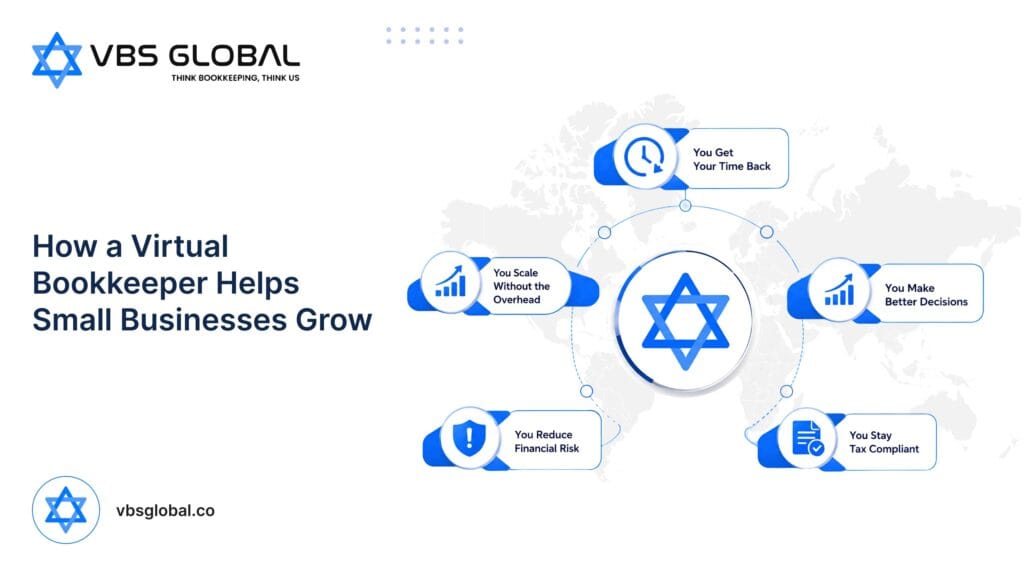
Hiring a virtual bookkeeper is not just about staying organised. It creates real growth opportunities for your business:
You Get Your Time Back
Time spent on bookkeeping is time taken away from your customers, your product, and your growth. A virtual bookkeeper handles the financial admin so you can focus on the things that actually move your business forward.
You Make Better Decisions
When your books are clean and your reports are up to date, you have accurate data to work with. Management reporting services give you the financial clarity to make smarter decisions about spending, hiring, pricing, and investment based on facts, not guesswork.
You Stay Tax Compliant
Tax laws change regularly, and mistakes are costly. A virtual bookkeeper keeps your records compliant throughout the year, reducing the risk of errors, penalties, and stressful last-minute filing.
You Reduce Financial Risk
Messy books lead to missed payments, incorrect tax filings, and poor cash flow visibility. A virtual bookkeeper reduces these risks by keeping your finances structured and accurate at all times.
You Scale Without the Overhead
As your business expands, your finances will also continue to become more complicated. Small business bookkeeping services scale with you, handling more transactions, more reports, and more complexity without the cost of hiring additional staff.
Signs Your Small Business Needs a Virtual Bookkeeper
Is the time right? Here are some clear signs that a virtual bookkeeper could make a real difference:
- Always Behind on Your Books: If you are regularly weeks or months behind on recording transactions, your financial picture is not accurate, and that creates real risk.
- Tax Season Causes Stress: If every tax deadline brings panic and last-minute scrambling, your bookkeeping process is not working. A virtual bookkeeper keeps your records tax-ready all year long.
- Your Real Profit: If you cannot confidently state your profit margin after all expenses, you do not have a clear enough view of your finances to make good business decisions.
- Too Much Time on Admin: If bookkeeping is eating into the time you should be spending on your actual business, that is a strong sign it is time to delegate.
- Your Business Is Growing: Growth is exciting, but it also means more transactions, more complexity, and more room for error. Virtual bookkeeping for startups and growing businesses makes scaling much smoother, giving you the financial structure you need from day one.
- You Are Ready to Delegate: If you are tired of managing everything yourself and want to focus on growth rather than admin, it is time to hire a virtual bookkeeper and put your financial affairs in competent hands.
Common Mistakes Small Businesses Make Without a Virtual Bookkeeper
Over the years, we have seen the same financial mistakes come up again and again in small businesses that manage their own books:
Mixing Personal and Business Finances
Using one bank account for both personal and business spending is one of the most common and damaging bookkeeping mistakes. It makes reconciliation nearly impossible and creates serious problems at tax time.
Falling Behind on Reconciliation
Leaving bank reconciliation for weeks or months at a time means errors pile up and become far harder to fix. Regular reconciliation is essential for accurate books.
Not Tracking Small Expenses
Small purchases add up. When business expenses are not properly recorded, such as coffee meetings, software subscriptions, and minor equipment, you end up overstating your profit and paying more tax than you should.
Ignoring Cash Flow
Many small business owners only look at cash flow when things go wrong. By then, it is often too late to course-correct easily. Outsourced Virtual CFO Services provide the high-level financial oversight needed to spot cash flow issues early and keep your business on track.
Is a Virtual Bookkeeper Safe and Secure?
This is a question many small business owners ask, and it is a fair one. You are trusting someone with sensitive financial data, and you want to know it is in safe hands.
Trustworthy virtual bookkeeping firms are also attentive to the security of your data. Here is what to expect from a trustworthy provider:
- Encrypted cloud storage: all financial data is stored securely and protected from unauthorised access
- Two-factor authentication: secure login processes to prevent data breaches
- Regular data backups: so your records are never at risk of being lost
- Confidentiality agreements: professional providers sign NDAs to protect your business information
- Compliance with data protection regulations: including GDPR and US data protection standards
As long as you choose a reputable provider with clear security protocols, working with a virtual bookkeeper is every bit as secure as having someone in-house.
How Much Does a Virtual Bookkeeper Cost?
Cost is one of the first questions small business owners ask, and honestly, it depends on a few key factors:
- Business Size – Smaller businesses with straightforward finances generally pay less than larger, more complex operations
- Transaction Volume – The more transactions your business processes, the more time and expertise are required
- Services Needed – Basic bookkeeping costs less than a full package that includes payroll, reconciliation, and financial reporting
- Software Used – Some platforms require additional setup or integration work that can affect pricing
- Frequency of Reporting – Monthly reports, weekly updates, or real-time access all come at different service levels
Compared to hiring a full-time in-house bookkeeper with salary, benefits, and employment overhead, outsourced bookkeeping services are significantly more affordable. You pay only for the services you actually need, with the flexibility to scale up or down as your business grows.
The best way to find out what it will cost for your business is to speak directly with a provider who can assess your specific needs and give you a clear, transparent quote.
How to Choose the Right Virtual Bookkeeper
Not every virtual bookkeeper is the right fit. Here is what to look for:
- Range of Services: The best providers offer more than just bookkeeping. Look for a team that also covers payroll, tax preparation, and virtual admin assistant services so all your back-office needs are handled under one roof.
- Software Knowledge: Make sure they are proficient in the accounting tools your business already uses or can help you move to a better system.
- Clear Communication: A good virtual bookkeeper is responsive, proactive, and easy to reach when you have questions. Communication matters as much as technical skill.
- Transparent Pricing: Avoid providers with unclear pricing structures. A trustworthy bookkeeper will be upfront about costs from day one.
- Solid References: Seek testimonials or case studies. A proven track record with satisfied clients is one of the best indicators of reliable service.
Why Small Businesses Choose VBS Global
At VBS Global, we have worked with small businesses across the USA and UK, helping them get their finances organised, stay compliant, and grow with confidence.
Our virtual bookkeeping service is built around what small businesses actually need: accurate books, clear reports, responsive support, and pricing that makes sense for where you are right now.
Here is what you get when you work with us:
- A dedicated team of qualified bookkeeping professionals
- Full-service support from daily transaction recording to payroll and tax preparation
- Cloud-based tools, including QuickBooks, Xero, and Zoho Books
- Real-time access to your financial data from any device
- Transparent pricing with no hidden fees
- Strong data security and confidentiality protocols
At VBS Global, we help small businesses stay organised, compliant, and free of financial stress. Book a Free 30-Minute Consultation and let our virtual bookkeeping experts handle your finances today.
Conclusion
Running a small business is hard enough without the added stress of managing your own finances. A virtual bookkeeper takes that burden off your plate, giving you accurate books, reliable reports, and the peace of mind that comes from knowing your finances are in good hands.
Whether you are just starting or ready to take your business to the next level, finding the right virtual bookkeeper for small business USA wide is one of the smartest investments you can make in the long-term health of your business.
FAQ
1. Is a virtual bookkeeper the same as an accountant?
Not exactly. A bookkeeper manages your day-to-day financial records, while an accountant analyses that data for tax planning, compliance, and strategic advice. Many virtual bookkeeping services, like VBS Global, offer both.
2. How do I share my financial documents with a virtual bookkeeper?
Most virtual bookkeepers work through cloud-based platforms like QuickBooks or Xero, where documents can be shared securely online. Some also use tools like Dext to capture receipts and invoices digitally.
3. Will a virtual bookkeeper work in my time zone?
Most reputable virtual bookkeeping services offer flexible scheduling and can accommodate different time zones. Always confirm availability and communication expectations before getting started.
4. How long does it take to get started?
Most virtual bookkeeping services can onboard a small business within one to two weeks. The process involves an initial consultation, account setup, and transfer of any existing financial records.
5. Can a virtual bookkeeper help with sales tax?
Yes. A good virtual bookkeeper will manage your sales tax obligations, ensuring the right taxes are collected, recorded, and filed on time, in compliance with all relevant regulations.