
Selling online is exciting. You have built a store, found your customers, and your orders are coming in. But somewhere between managing inventory, processing refunds, and chasing supplier invoices, the financial side of your business starts to feel like a full-time job on its own for E-commerce Sellers.
And for most e-commerce sellers, it quickly becomes one.
Accounting for e-commerce sellers is not the same as managing finances for a traditional business. You are dealing with multiple sales channels, complex tax rules, high transaction volumes, and platform fees that all need to be tracked accurately. One mistake can mean incorrect tax filings, cash flow problems, or a financial picture that does not reflect reality.
The good news is that you do not have to figure it all out yourself. Outsourced bookkeeping gives ecommerce sellers access to professional financial management without the cost or complexity of building an in-house team.
This guide covers everything you need to know about accounting for e-commerce businesses in 2026, what it involves, why it matters, and how outsourcing can make it simpler and more effective.
What is E-commerce Accounting?
E-commerce accounting is the process of recording, organising, and managing all financial transactions related to an online business. This includes tracking sales revenue, processing refunds, managing inventory costs, handling platform fees, and ensuring compliance with tax regulations.
Unlike traditional retail accounting, ecommerce businesses often operate across multiple platforms, such as Amazon, Shopify, eBay, and WooCommerce, each with its own reporting format, fee structure, and payment cycle. This adds a layer of complexity that requires specialist knowledge and structured processes to manage correctly.
Done well, e-commerce bookkeeping services give you a clear and accurate picture of your business’s financial health, helping you make smarter decisions, plan for growth, and stay fully compliant.
Why Accounting Is Important For E-commerce
Many e-commerce sellers focus heavily on marketing, product sourcing, and customer experience, and leave accounting as an afterthought. That is a mistake that can cost you significantly over time.
Here is why accounting is one of the most important parts of running a successful e-commerce business:
Financial Clarity
Without accurate books, you do not truly know how much your business is making or spending. Revenue looks good on the surface, but after platform fees, shipping costs, returns, and advertising spend, your actual profit margin might be very different from what you expect.
Tax Compliance
E-commerce sellers in the USA face complex sales tax requirements. With economic nexus laws varying by state, you could be liable to collect and remit sales tax in multiple states even if you do not have a physical presence there. Getting this wrong leads to penalties that add up fast.
Cash Flow Management
E-commerce businesses often have uneven cash flow, with high sales periods followed by quiet ones, inventory purchases that require upfront investment, and delayed payouts from platforms like Amazon. Proper accounting helps you plan for these fluctuations and avoid cash flow shortfalls.
Business Growth
If you want to scale your ecommerce business, whether that means expanding to new platforms, hiring staff, or seeking investment, you need clean, accurate financial records. Accounting services for e-commerce businesses help you build that foundation so investors and lenders take you seriously.
Biggest Accounting Challenges E-Commerce Sellers Face
Accounting for e-commerce sellers comes with a unique set of challenges that make it more complex than standard bookkeeping. Here are the most common ones:
Multiple Sales Channels
Selling on Amazon, Shopify, and eBay simultaneously means dealing with three different reporting systems, three different fee structures, and three different payment schedules. Keeping all of this organised manually is time-consuming and error-prone.
High Transaction Volumes
E-commerce businesses can process hundreds or thousands of transactions every day. Recording each one accurately, including refunds, chargebacks, and partial payments, requires a structured and efficient system.
Sales Tax Complexity
Since the South Dakota v. Wayfair ruling, e-commerce sellers in the USA must collect sales tax in any state where they meet economic nexus thresholds. Sales tax compliance for e-commerce businesses is one of the most challenging aspects of financial management and one of the most common reasons sellers turn to professional support.
Inventory Accounting
Tracking the cost of goods sold (COGS) accurately is essential for understanding your true profit margins. But when you are managing large or varied inventories or using third-party fulfilment like Amazon FBA, this becomes significantly more complex.
Platform Fees and Deductions
Each platform deducts fees, commissions, and advertising costs before paying you. These need to be properly recorded and categorised to get an accurate picture of your revenue and expenses.
Returns and Refunds
High return rates are common in e-commerce. Each refund needs to be recorded correctly, affecting revenue, inventory levels, and potentially sales tax obligations all at once.
What is Outsourced Bookkeeping for E-commerce Sellers?
Outsourced bookkeeping for e-commerce sellers means hiring an external team of financial professionals to manage your day-to-day accounting tasks so you can focus on growing your business instead of getting buried in spreadsheets.
Your outsourced team works remotely using cloud-based accounting tools like QuickBooks, Xero, or A2X, integrating directly with your ecommerce platforms to pull in transaction data, reconcile accounts, and keep your books accurate and up to date.
It is not just about saving time. It is about having professionals who understand the specific financial complexities of e-commerce sales tax, inventory accounting, multi-channel reporting, and delivering bookkeeping and accounting services with the expertise your business requires.
Key Services E-commerce Sellers Need
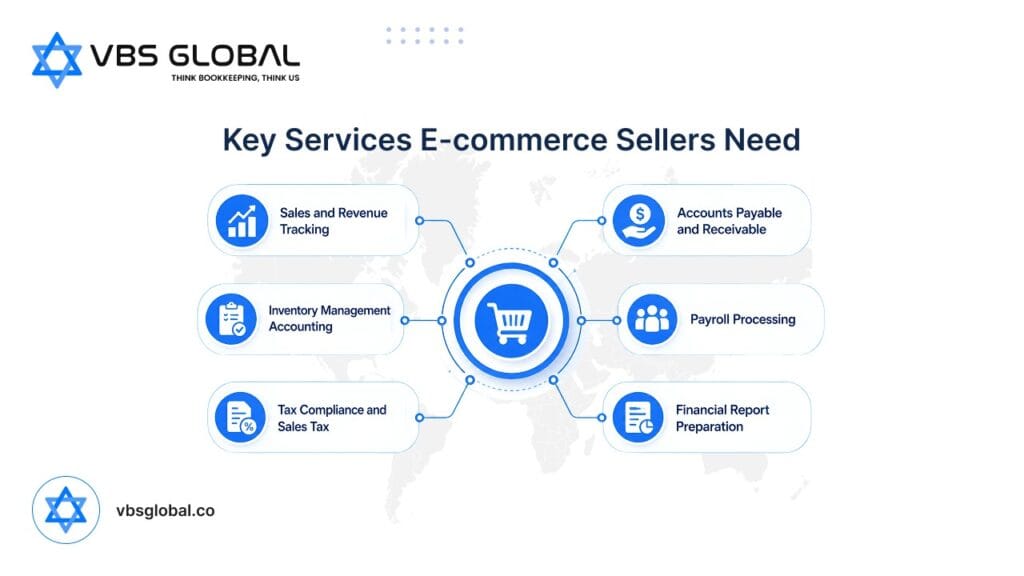
A good outsourced bookkeeping service for e-commerce covers far more than basic transaction recording. Here is what professional support typically includes:
Sales and Revenue Tracking
Every sale across every platform is recorded accurately, including gross revenue, platform fees, refunds, and net payouts. This gives you a clear and honest view of your actual income, not just your top-line sales figures.
Inventory Management Accounting
Tracking inventory costs, COGS, and stock levels is essential for accurate profit reporting. Professional bookkeepers manage this systematically, whether you hold your own stock or use third-party fulfilment services.
Tax Compliance and Sales Tax
Staying compliant with multi-state sales tax obligations is one of the most complex aspects of accounting for e-commerce sellers. Your outsourced team monitors your nexus thresholds, ensures the right taxes are collected, and manages filings across all relevant states.
Accounts Payable and Receivable
Outsourced accounts payable services take care of all supplier payments and outstanding invoices, keeping your cash flow organised and ensuring nothing falls through the cracks.
Payroll Processing
If you have employees or contractors, payroll needs to be processed accurately and on time, including tax deductions, compliance with federal and state regulations, and timely payments.
Financial Report Preparation
Regular profit and loss statements, balance sheets, and cash flow reports give you a clear picture of your business performance every month so you can make informed decisions.
Benefits of Outsourced Bookkeeping for E-commerce Sellers
Outsourcing your bookkeeping is not just about convenience. It delivers real, measurable benefits for your e-commerce business:
- Save Time Every Week: Managing ecommerce finances manually takes hours. Outsourcing gives you that time back time you can put into product development, marketing, and customer acquisition.
- Accurate Books. Always: Professional bookkeepers follow structured processes and quality checks. Your records are accurate, your reports are reliable, and your tax filings are correct every time.
- Stay Tax Compliant: With multi-state sales tax obligations and complex IRS requirements, having professionals manage your tax compliance reduces the risk of errors, penalties, and audits significantly.
- Better Cash Flow Visibility: When your books are clean and up to date, you always know exactly where your money is. This makes it much easier to plan inventory purchases, manage seasonal fluctuations, and avoid cash flow problems before they happen.
- Scale With Confidence: As your e-commerce business grows, your financial complexity grows with it. Outsourced bookkeeping scales with you, handling increased transaction volumes and more complex reporting without you needing to hire additional staff.
- Lower Costs Than In-House Hiring: A full-time bookkeeper is expensive. E-commerce accounting services USA providers offer the same or better quality of financial management at a fraction of the cost, with no employment overhead.
Popular E-commerce Platforms and Their Accounting Needs
Different platforms come with different financial complexities. Here is what e-commerce sellers on each major platform need to know:
Amazon Sellers
Amazon’s fee structure is complex, with referral fees, FBA fulfilment fees, storage fees, and advertising costs all needing to be tracked separately. Amazon seller bookkeeping services handle these complexities, reconciling payouts with actual sales data and managing sales tax collection through Amazon’s Marketplace Facilitator rules across different states.
Shopify Sellers
Shopify gives you more control over your financial data, but that also means more responsibility. Payment processing fees, subscription costs, and app charges all need to be recorded. If you sell across multiple countries, currency conversion and international tax obligations add further complexity.
eBay Sellers
eBay’s managed payments system has simplified some aspects of financial management, but final value fees, promoted listing charges, and return costs still need to be carefully tracked. For high-volume eBay sellers, reconciling transactions manually is simply not practical.
WooCommerce Sellers
WooCommerce gives you complete control over your store, but also complete responsibility for your financial data. Without automatic reporting, WooCommerce sellers need robust bookkeeping systems to track sales, fees, and taxes accurately across all their payment gateways.
Tools Used for E-commerce Accounting
The right tools make e-commerce accounting significantly more manageable. Here are the most widely used platforms:
- QuickBooks Online: One of the most popular accounting platforms globally. QuickBooks integrates with most e-commerce platforms and payment processors. It is ideal for tracking income, expenses, and taxes in real time.
- Xero: Xero is a cloud-based accounting tool known for its clean interface and strong integration capabilities. It works well for e-commerce businesses that need multi-currency support and real-time financial reporting.
- A2X: A2X is specifically designed for e-commerce accounting. It automatically pulls settlement data from Amazon, Shopify, eBay, and other platforms, categorising fees, refunds, and payouts accurately before posting to your accounting software.
- Zoho Books: Zoho Books is a cost-effective option for smaller ecommerce businesses. It offers solid invoicing, expense tracking, and tax management features with good integration options.
- TaxJar / Avalara: For managing multi-state sales tax compliance, TaxJar and Avalara are the leading tools. They automate sales tax calculations, filing, and remittance, saving ecommerce sellers significant time and reducing compliance risk.
Signs Your E-commerce Business Needs Outsourced Bookkeeping
Not sure if outsourcing is right for you right now? Here are some clear signs it might be time to make the move:
1. You Do Not Know Your Real Profit Margin: If you cannot confidently state your actual profit after all fees, returns, and expenses, your books need attention.
2. Tax Season Causes Panic: If you spend weeks scrambling to pull together financial records every time tax season arrives, that is a sign your bookkeeping process is not working.
3. Your Business Is Growing Fast: Rapid growth is exciting but it also means more transactions, more complexity, and more room for error. Outsourcing gives you the structure to scale without the financial mess.
4. You Are Selling on Multiple Platforms: Managing finances across Amazon, Shopify, and eBay simultaneously is genuinely difficult without professional support. Bookkeeping for Online sellers who operate across multiple channels requires structured processes and specialist knowledge. Outsourcing is the smart choice.
5. You Have Received a Tax Notice: If HMRC or the IRS has flagged your business for incorrect filings or missed obligations, it is time to get professional support in place immediately.
At VBS Global, we make accounting for e-commerce sellers simple, accurate, and affordable. Book a Free 30-Minute Consultation and let our team take the stress out of your finances today.
Smart Financial Management Tips for E-commerce Brands
Even with outsourced bookkeeping in place, some simple habits will help you stay financially healthy:
- Separate Business and Personal Finances: Make sure you get both a separate business bank account and a credit card. Intermingling business and personal accounts makes bookkeeping incredibly complicated and causes trouble at tax time. Professional CPA bookkeeping services help you maintain clear financial separation, improve accuracy, and stay compliant with tax regulations.
- Reconcile Accounts Monthly: Do not wait until year-end to check your books. Monthly reconciliation catches errors early and keeps your financial picture accurate throughout the year.
- Track Inventory Costs Carefully: Know your COGS at all times. Understanding the true cost of your products is essential for pricing correctly and protecting your profit margins.
- Plan for Tax Payments: Set aside a percentage of revenue each month for tax obligations. E-commerce sellers who do not plan for sales tax and income tax often find themselves short when payments are due.
- Review Financial Reports Regularly: Make it a habit to review your profit and loss statement every month. Understanding your numbers helps you make better decisions and spot problems before they grow.
Why E-commerce Sellers Choose VBS Global
At VBS Global, we know that accounting for e-commerce sellers is not one-size-fits-all. Every platform is different, every business is unique, and you deserve support that actually fits how you operate.
- E-commerce-Specific Expertise: Our team has hands-on experience with Amazon, Shopify, eBay, and WooCommerce, from platform fees and multi-channel reconciliation to e-commerce tax compliance.
- Full-Service Financial Management: Full-service financial management covers everything from transaction recording and inventory accounting to sales tax compliance and reporting. With expert support and outsourced bookkeeping CPA firms USA, businesses can manage finances efficiently and focus on growth.
- Cloud-Based and Real-Time: We work with QuickBooks, Xero, and A2X, giving you real-time access to your financial data from any device, anytime.
- Sales Tax Compliance: We monitor your nexus obligations, manage multi-state filings, and keep you fully compliant, with no unexpected tax bills, ever.
- Affordable and Scalable: Whether you process 100 orders or 10,000 a month, our services scale with your business at a cost that makes sense.
- Dedicated Support: You get a dedicated team that knows your business inside out, not a generic service that treats every client the same.
Conclusion
Running a successful e-commerce business in 2026 means more than just getting products in front of customers. It means having clean, accurate financial records, staying on top of tax obligations, and making decisions based on real data, not guesswork.
Accounting for e-commerce sellers is genuinely complex. But it does not have to be your problem to solve alone.
Outsourced bookkeeping gives you access to professionals who understand e-commerce finance inside and out, handling everything from multi-channel reconciliation to sales tax compliance while you focus on what you do best: building and growing your store.
If you are ready to take the stress out of your e-commerce finances, VBS Global is here to help. Get in touch today and let us handle the numbers while you handle the business.
Visit us: Bookkeeping and Accounting Services for Startups in USA
FAQ
1. Do e-commerce sellers need an accountant or a bookkeeper?
Most e-commerce sellers need both. A bookkeeper manages your day-to-day financial records, while an accountant handles tax planning, compliance, and strategic financial advice. Many outsourced services, like VBS Global, are provided under one roof.
2. How do I handle sales tax as an e-commerce seller in the USA?
You need to collect and remit sales tax in any state where you meet the economic nexus threshold, typically $100,000 in sales or 200 transactions. Tools like TaxJar or Avalara can help automate this, and a professional bookkeeping team can manage filings on your behalf.
3. What accounting software is best for e-commerce sellers?
QuickBooks Online and Xero are the most popular options. For Amazon and Shopify sellers specifically, combining one of these with A2X significantly simplifies multi-channel reconciliation.
4. How much does outsourced bookkeeping cost for e-commerce businesses?
Costs vary depending on your transaction volume, platforms, and the services you need. Most ecommerce sellers pay between $300 to $1,000 per month for professional outsourced bookkeeping, far less than the cost of hiring in-house.
5. Can outsourced bookkeeping handle multiple e-commerce platforms?
Yes. A good outsourced bookkeeping team will manage your finances across all your sales channels, reconciling data from each platform and giving you a single, unified view of your business finances.