

Healthcare claim denials can delay payments, increase administrative work, and put pressure on billing teams. Repeated denials can also point to problems earlier in the revenue cycle. Identifying these issues early can help reduce avoidable denials.
Better eligibility checks, accurate registration, proper authorization, documentation, coding, and claim review can improve claim accuracy. This guide explains how to reduce claim denials in healthcare, common causes, denial handling, key KPIs, and when RCM support may help.
What Are Healthcare Claim Denials?
A healthcare claim denial occurs when an insurance payer does not approve payment for all or part of a submitted claim. Common causes include incorrect patient information, missing authorization, coding errors, documentation issues, coverage requirements, and filing problems.
A claim denial is different from a claim rejection. A rejected claim has an issue preventing it from moving through the claims process, while a denied claim has been reviewed by the payer but payment was not approved, requiring correction, documentation, an appeal, or follow-up as part of Revenue Cycle Management Services.
Why Do Healthcare Claim Denials Matter?
A denied claim is not just a billing issue. It can create additional work across the revenue cycle.
When a claim is denied, the billing team may need to:
- Review the payer’s response
- Find the reason for the denial
- Check patient and claim information
- Review coding and documentation
- Correct the issue
- Submit a corrected claim or appeal
- Follow up with the payer
- Track the final outcome
That is why claim denial prevention should start before the claim is submitted.
What Are the Common Types of Healthcare Claim Denials?
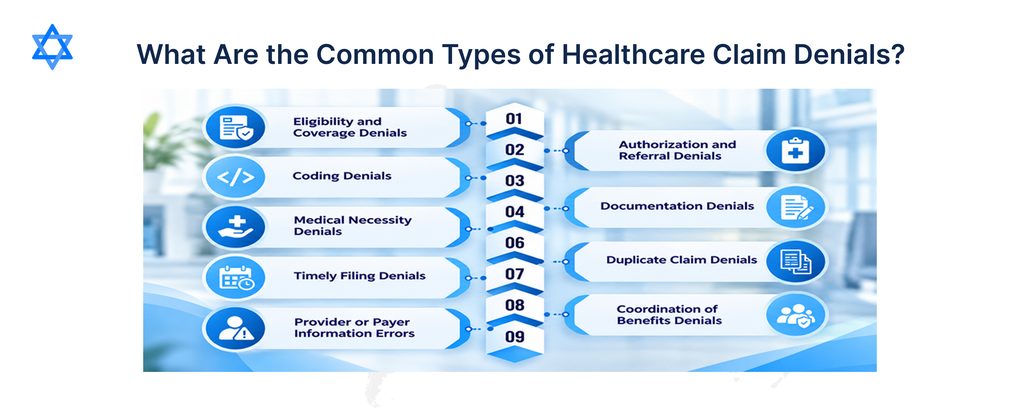
Healthcare claim denials can happen for different reasons, and the exact pattern can vary by payer, service, and provider.
1. Eligibility and Coverage Denials
These can occur when coverage is inactive, insurance information is incorrect, or the service is not covered under the patient’s plan.
2. Authorization and Referral Denials
These may occur when required prior authorization or referral information is missing, incorrect, expired, or does not match the service.
3. Coding Denials
Incorrect diagnosis codes, procedure codes, modifiers, units, or other coding issues can affect claim processing.
4. Documentation Denials
A payer may require documentation that supports the service billed. Missing or incomplete records can create payment problems.
5. Medical Necessity Denials
Some services may be denied when the payer determines that the documentation does not support its medical-necessity or coverage requirements.
6. Duplicate Claim Denials
Submitting the same claim more than once can result in a duplicate claim denial.
7. Timely Filing Denials
Claims submitted after the applicable payer filing deadline may not be paid.
8. Coordination of Benefits Denials
When a patient has more than one insurance plan, incorrect or incomplete coordination of benefits information can create claim problems.
9. Provider or Payer Information Errors
Incorrect provider details, payer information, or other required claim data can also lead to processing problems.
What Causes Healthcare Claim Denials?
Most claim denials do not come from one single problem. They can result from issues at different stages of the revenue cycle.
Common causes include:
- Inaccurate patient registration
- Incorrect insurance information
- Eligibility not verified
- Missing prior authorization
- Incomplete referrals
- Coding errors
- Documentation gaps
- Incorrect charge capture
- Missing or incorrect claim information
- Payer-specific requirements
- Duplicate submissions
- Missed filing deadlines
- Coordination of benefits issues
- Lack of claim follow-up
How to Reduce Claim Denials in Healthcare: 10 Strategies
Reducing claim denials requires more than fixing claims after they are denied. Healthcare providers RCM needs a process that catches avoidable problems earlier and learns from recurring issues.
1. Verify Eligibility Before the Visit
Eligibility verification should be part of the front-end revenue cycle.
Before providing a service, verify the patient’s insurance coverage, member information, benefits, and other relevant details.
The goal is to identify potential coverage problems before the claim is submitted.
A consistent eligibility process can help reduce avoidable coverage and insurance-related claim issues.
2. Confirm Prior Authorization
Some healthcare services require prior authorization or referrals.
Do not wait for a claim denial to discover that authorization was required.
Before the service, confirm:
- Whether authorization is required
- Whether the authorization is still valid
- Whether it applies to the correct service
- Whether the provider is included
- Whether the authorization number is recorded correctly
- Whether any referral is required
Keeping authorization information connected to the patient’s billing record can also make later claim review easier.
3. Keep Patient Information Accurate
Patient registration is one of the first places where claim problems can begin.
Make sure information such as the patient’s name, date of birth, insurance details, member ID, group number, and other required information is accurate.
For patients with more than one insurance plan, coordination of benefits information should also be reviewed carefully.
A small error at registration can become a much bigger issue later in the revenue cycle.
4. Strengthen Clinical Documentation
The medical record should support the services that are billed.
Incomplete or unclear documentation can make it harder to support a claim during payer review.
Healthcare organizations should have clear documentation processes and make sure staff understand what information is needed for the services they provide.
Good documentation also gives coding and billing teams the information they need to prepare accurate claims.
5. Improve Coding and Charge Capture
Every service that should be billed needs to be captured accurately.
Charge capture and coding should match the actual care provided and the supporting documentation.
Review areas such as:
- Diagnosis codes
- Procedure codes
- Modifiers
- Units
- Place of service
- Provider information
- Supporting documentation
Coding errors can create avoidable medical billing claim denials, so regular review and staff education can be valuable for denial management in medical billing.
6. Scrub Claims Before Submission
A claim review before submission can help catch errors before the payer receives the claim.
Depending on the provider’s workflow, the review may check:
- Patient information
- Insurance details
- Coding
- Modifiers
- Authorization
- Provider information
- Missing fields
- Payer requirements
Claim-scrubbing technology can also help identify certain issues automatically.
The goal is simple: submit accurate claims the first time whenever possible.
7. Follow Payer Rules and Deadlines
Not all payers follow the same requirements.
Healthcare providers may work with Medicare, Medicaid, and commercial payers, each with different processes and requirements.
Billing teams should maintain updated information about payer rules, authorization requirements, documentation needs, claim submission processes, and filing deadlines.
Submitting an accurate claim is important, but submitting it according to the correct payer requirements is equally important.
8. Monitor Claim Status
Claim management does not end when a claim is submitted.
Teams should monitor claim status and payer responses so that problems can be addressed without unnecessary delay.
A claim that is pending, rejected, denied, or under review may require a different next step.
Regular monitoring can help prevent unresolved claims from sitting in the system for too long.
9. Track Denial Patterns
Simply counting the number of denied claims is not enough.
Healthcare providers should look at:
- Denial reason
- Payer
- Service type
- Provider
- Location
- Number of denied claims
- Dollar value of denied claims
- Age of the denied claim
- Resolution status
This information can show where the biggest problems are.
For example, if one payer is responsible for a large share of authorization-related denials, the provider may need to review its authorization workflow for that payer.
10. Use Root-Cause Analysis
The final step is to turn denial data into action.
If a denial happens repeatedly, ask:
Why does this keep happening?
The answer may be related to registration, eligibility, authorization, coding, documentation, claim submission, or payer requirements.
Once the root cause is identified, the organization can update its process, train staff, improve technology, or add a quality check.
How to Handle a Denied Healthcare Claim
Even with a strong prevention process, some claims may still be denied. A structured approach helps billing teams resolve denials efficiently and reduce repeat issues.
1. Review the Denial Reason
Check the payer’s response to understand why the claim was denied and identify the specific issue that needs attention.
2. Check the Original Claim
Review patient information, insurance details, authorization, coding, documentation, dates, and other claim details against the patient’s records.
3. Correct the Root Cause
Identify the cause of the denial and make the necessary corrections or gather any missing information before resubmitting the claim.
4. Appeal When Appropriate
If the denial is eligible for appeal, follow the payer’s process and submit the required documentation and supporting information.
5. Follow Up and Track the Outcome
Monitor the corrected claim or appeal, follow up with the payer, and record the outcome to identify recurring denial patterns.
How Technology Can Help Prevent Claim Denials
Technology can support denial prevention, but it does not replace a strong process.
Depending on the provider’s systems, technology can help with:
- Eligibility checks
- Authorization alerts
- Claim scrubbing
- Coding checks
- Missing-field detection
- Claim-status monitoring
- Denial categorization
- Reporting
- Trend analysis
- Automated alerts
EHR, practice management, billing, and Revenue cycle management in healthcare can also help connect information across different stages of the revenue cycle.
Key Healthcare Denial Management KPIs to Track
Tracking the right metrics helps providers understand whether their denial management healthcare process is improving.
Claim Denial Rate: This shows the percentage of submitted claims that are denied.
Denials Rate by Reason: Breaking denials down by reason can show which issues are creating the most problems.
Denial Rate by Payer: Comparing denial patterns across payers can help identify payer-specific issues.
Denial Dollar Amount: The number of denied claims is only part of the picture. The financial value of those denials also matters.
Appeal Success Rate: This measures how often appealed claims are successfully resolved.
Days to Resolve Denials: This shows how long denied claims remain unresolved.
Accounts Receivable Aging: AR aging helps providers see how long outstanding balances have remained unpaid.
Clean Claim Rate: A clean claim rate can help show how effectively the organization is preparing claims before submission.
What Does a Denial Management Workflow Look Like?
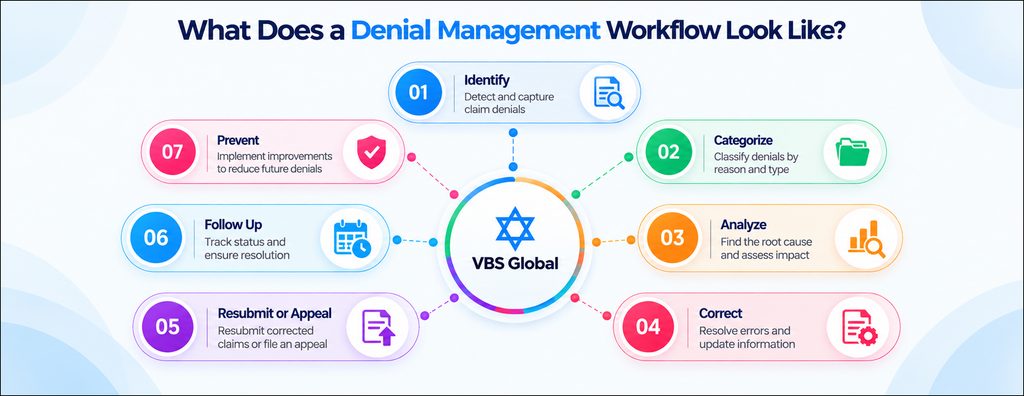
A strong denial management workflow connects prevention, recovery, and continuous improvement.
Each step has a purpose.
- Identify: Find the denied claim and understand its status.
- Categorize: Group the denial by reason, payer, service, or other useful factors.
- Analyze: Determine what caused the denial.
- Correct: Fix the issue when correction is possible.
- Resubmit or Appeal: Take the appropriate next step based on the payer’s requirements.
- Follow Up: Monitor the claim until the issue is resolved.
- Prevent: Use the information to reduce similar denials in the future.
When Should Healthcare Providers Consider Denial Management Services?
Internal teams can manage denials effectively when the workload, staffing, and processes are under control.
However, additional support may be worth considering when a provider is dealing with:
- Recurring claim denials
- Increasing accounts receivable
- High claim volume
- Delayed reimbursement
- Limited billing staff
- Repetitive denial follow-up
- Poor denial visibility
- Difficulty identifying root causes
- Growing administrative workload
In these situations, denial management services can provide additional support with denial review, follow-up, resolution, reporting, and trend analysis.
What Can an Outsourced RCM Team Do for Claim Denial Management?
An outsourced RCM team can support several stages of the healthcare revenue cycle.
Depending on the agreed scope, support may include:
- Patient registration
- Insurance verification
- Authorization support
- Charge capture
- Medical coding
- Claims submission and management
- Payment posting
- Denial management
- Accounts receivable follow-up
- Revenue cycle reporting and analytics
VBS Global’s current RCM service offering for U.S. healthcare providers covers these key areas, including claims management, denial follow-up, payment posting, and AR management.
How to Choose the Right RCM Partner for Denial Management
Before choosing an RCM partner, healthcare providers should understand how the company manages claims, denials, reporting, communication, and data.
Healthcare RCM Experience
Look for experience with healthcare billing and the type of organization you operate.
Denial Management Process
Ask how the provider identifies denial reasons, manages follow-up, handles appropriate appeals or corrections, and tracks recurring issues.
Reporting and KPIs
The RCM partner should provide clear reporting that helps you understand claims, denials, payments, AR, and other relevant performance indicators.
Communication
Understand how often your team receives updates and who will handle questions or escalations.
Data Security
Healthcare billing involves sensitive information. Review the partner’s security and data-handling practices before sharing information.
Scalability
Your RCM partner should be able to support changes in claim volume and operational requirements as your organization grows.
Reduce Claim Denials With Better RCM Support
VBS Global provides Revenue Cycle Management Services for U.S. healthcare providers to support claims, denial follow-up, AR, and payment workflows. If recurring denials or delayed payments are affecting your practice, we can help identify gaps and improve your revenue cycle. Get a Free RCM Assessment today.
Ready to reduce avoidable denials? Get a Free RCM Assessment and identify opportunities to improve your revenue cycle.
FAQs About Healthcare Claim Denials
How can healthcare providers prevent claim denials?
Healthcare providers can reduce avoidable denials by verifying eligibility, confirming authorization, maintaining accurate patient information, improving documentation and coding, reviewing claims before submission, and analyzing recurring denial patterns.
What are the most common causes of healthcare claim denials?
Common causes include eligibility problems, missing authorization, inaccurate patient or insurance information, coding and documentation errors, coverage issues, coordination of benefits problems, and filing issues.
What should a provider do after a claim is denied?
Review the denial reason, check the original claim and supporting records, identify the root cause, correct the issue, and resubmit or appeal when appropriate. Follow up with the payer and track the outcome.
Which denial management KPIs should healthcare providers track?
Useful metrics include denial rate, denial rate by reason and payer, denied dollar amount, appeal success rate, days to resolve denials, clean claim rate, and accounts receivable aging.
Can outsourced RCM services help reduce claim denials?
Yes. An outsourced RCM team can support eligibility, authorization, claims management, denial follow-up, payment posting, AR management, and reporting based on the provider’s specific needs.