
Bookkeeping may start as a manageable part of running a business, but it can become difficult to keep up with as transactions increase and responsibilities pile up. Many business owners end up handling financial records late at night, putting off reconciliations, or relying on outdated numbers when making decisions.
At some point, it becomes worth asking when to outsource bookkeeping instead of continuing to manage everything internally. The decision usually comes down to workload, accuracy, reporting needs, available staff, and how much time bookkeeping is taking away from running the company.
Outsourcing is not the right answer for every business. The decision usually comes down to workload, accuracy, reporting needs, available staff, and how much time bookkeeping is taking away from running the company.
When Should You Consider Outsourcing Your Bookkeeping?
There is no single point at which every business should outsource. Some companies may need outside help early because they have limited accounting resources, while others manage comfortably in-house for years.
The important thing is to notice when your current setup is no longer working as it should. Falling behind, spending too much management time on bookkeeping, or struggling to get reliable financial information are all signs that your existing approach may need to change. Outsourced Bookkeeping and Accounting Services can help businesses manage these challenges with consistent financial support.
7 Signs It’s Time to Outsource Your Bookkeeping
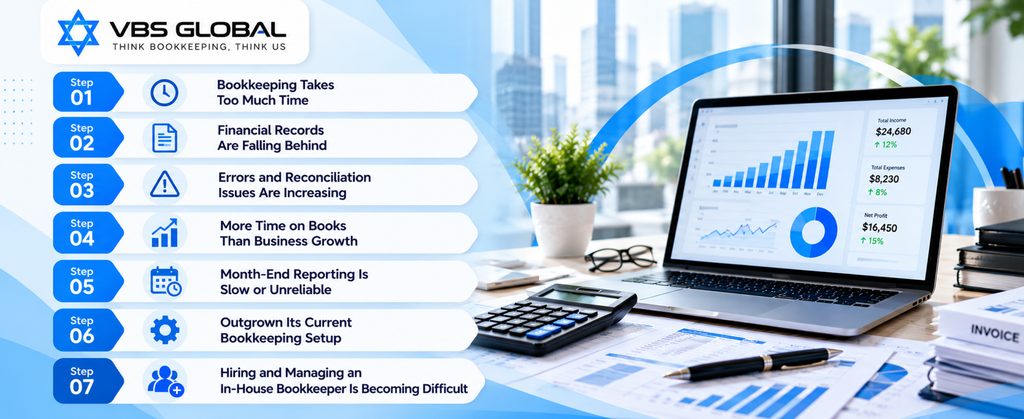
1: Bookkeeping Takes Too Much Time
Bookkeeping can quietly consume hours that could be spent on customers, sales, operations, or planning. If you or your employees are regularly setting aside large parts of the week to enter transactions, review records, or catch up on financial work, it may be time to reconsider who should handle it.
2: Financial Records Are Falling Behind
When bookkeeping gets pushed aside, records can quickly become outdated. A delay of a few days may turn into weeks, making it harder to see your current financial position. Once the gap becomes difficult to close, bringing in outside support can help get the books back on a consistent schedule.
3: Errors and Reconciliation Issues Are Increasing
Repeated mistakes, unexplained differences, or account reconciliation problems can point to weaknesses in the current process. Even small errors can affect reports and make financial information harder to trust. A more structured bookkeeping process can reduce these issues and make discrepancies easier to identify.
4: More Time on Books Than Business Growth
Business owners should be able to focus on running and developing the company. When bookkeeping starts taking attention away from growth, customers, employees, or strategic planning, the cost is more than just the hours spent on accounting tasks. Moving routine financial work to a dedicated provider can give that time back to the business.
5: Month-End Reporting Is Slow or Unreliable
If month-end arrives and your numbers are still being pulled together, it becomes harder to understand how the business performed. Delayed or inconsistent reports can also make planning more difficult. Regular bookkeeping support can help keep financial information organized so month-end review services do not become a last-minute exercise.
6: Outgrown Its Current Bookkeeping Setup
A bookkeeping process that worked when your business had a few accounts and limited transactions may not work after significant growth. More customers, higher transaction volume, additional accounts, new locations, or changing reporting needs can put pressure on a simple setup. When the process starts becoming too complicated to manage efficiently, it may be time for a different approach.
7: Hiring and Managing an In-House Bookkeeper Is Becoming Difficult
Hiring a bookkeeper is not only about finding a qualified person. You also need to recruit, onboard, manage, and retain them. For some businesses, maintaining a full in-house bookkeeping role may not make sense. In those situations, an accounting outsourcing firm can provide access to financial support without requiring the business to manage every staffing responsibility internally.
In-House vs. Outsourced Bookkeeping: What Should You Consider?
The right choice depends on how your business operates and what your current accounting setup can realistically handle.
- Cost structure: One consideration. An in-house employee comes with salary and employment-related costs, while outsourced support is usually structured around the services and level of assistance required.
- Expertise: Also matters. An internal bookkeeper may know your business well, while an outsourced provider may offer access to a broader accounting team with experience across different bookkeeping needs.
- Scalability: Can become important as your business changes. An internal role may be harder to adjust, while an outsourced arrangement can sometimes be expanded or reduced around workload and requirements.
- Workload: Is another practical factor. If bookkeeping is no longer a small part of the job and has become a major ongoing responsibility, outsourcing may provide a clearer division of work.
- Reporting: Should also be considered. Businesses need financial information that is current and useful, not simply records that have been entered.
Finally, think about management time. Recruiting and supervising accounting staff takes effort. That effort should be part of the overall comparison.
What Should You Look for in an Outsourced Bookkeeping Provider?
- Accounting Experience: Look at the provider’s accounting experience and whether the team understands your business’s financial needs.
- Software Compatibility: Make sure the provider can work with your current accounting platform or recommend a suitable setup.
- Data Security: Check how access is controlled and how sensitive financial information is handled throughout the engagement.
- Communication & Reporting: Understand how often your financial information is reviewed, who you can contact, and how updates will be shared.
- Scalability & Industry Experience: Consider whether the provider has relevant industry experience and can adjust its level of support as your business changes.
Is Outsourcing Bookkeeping Right for Your Business?
The answer depends on your current situation rather than business size alone. A small company may outsource because there is no internal accounting resource, while a larger business may do so because its existing team is overloaded or needs additional support.
Look at what your current bookkeeping process is costing you in time, delays, missed information, and management attention. If keeping the books current has become difficult, exploring the best accounting firm may be a practical next step.
The goal is not simply to move bookkeeping somewhere else. It is to create a setup that keeps financial records organized and gives the business access to the information it needs without creating unnecessary internal workload.
Frequently Asked Questions
When should a business outsource bookkeeping?
A business may consider outsourcing when bookkeeping takes too much time, records are falling behind, errors are increasing, reporting is delayed, or the existing setup no longer fits the company’s needs.
What are the signs you need outsourced bookkeeping?
Common signs include overdue bookkeeping, increasing reconciliation issues, unreliable month-end reporting, growing transaction volume, and business owners spending too much time on financial administration.
Is outsourced bookkeeping better than hiring in-house?
Neither approach is automatically right for every business. The decision depends on cost, workload, expertise, management requirements, reporting needs, and how much flexibility the business wants.
What does outsourced bookkeeping include?
The scope varies by provider and business needs. It may include maintaining financial records, recording transactions, account reconciliation, reporting, and other ongoing bookkeeping responsibilities.
Can a growing business outsource bookkeeping?
Yes. Growing businesses often use outside bookkeeping support when their transaction volume increases, or their existing team no longer has enough capacity to keep financial records current.
Take the Next Step With VBS Global
When bookkeeping starts taking more time than it should, changing the way the work is managed can make a meaningful difference. VBS Global provides flexible bookkeeping support for businesses that need accurate records, consistent financial work, and less pressure on their internal teams. Get a Free Consultation