

Healthcare providers can deliver excellent patient care and still face cash flow problems when insurance verification, medical billing, claims, and payment follow-up do not work smoothly. Incorrect patient information, missing authorizations, and billing errors can delay reimbursement and create extra work for staff.
To improve healthcare revenue cycle management (RCM), practices should verify insurance information early, submit accurate claims, investigate denial patterns, follow up on unpaid balances, and review financial performance regularly. These steps help teams identify problems earlier and keep the payment process organized.
Improving revenue cycle management services does not mean changing everything at once. This guide explains eight practical fixes, the common challenges behind them, which metrics to track, and a simple 30-day plan you can start with.
Common Healthcare Revenue Cycle Management Challenges
Revenue cycle management covers the financial process from patient registration through final payment. Each stage depends on accurate information and timely action. When one part of the process breaks down, it can affect the rest of the revenue cycle.
Common challenges include:
- Incorrect patient information: Errors in names, dates of birth, insurance IDs, or policy details can lead to claim rejections or processing delays.
- Insurance eligibility issues: Coverage may be inactive, benefits may be limited, or the patient’s plan may not cover the service.
- Prior authorization delays: Missing or incorrect authorization details can delay treatment or create claim problems.
- Coding and documentation errors: Incomplete clinical records or inaccurate medical codes can affect claim processing.
- High claim denial rates: Repeated denials create extra work and delay payment collection.
- Slow accounts receivable follow-up: Unpaid claims may remain unresolved when follow-up is inconsistent.
- Patient billing issues: Unclear statements or limited payment options can make it harder for patients to understand and pay their balances.
- Limited performance reporting: Without regular reports, practices may struggle to identify where claims or payments are getting stuck.
The best place to start is by identifying which of these problems has the greatest effect on your practice.
5 Practical Ways to Improve Healthcare Revenue Cycle Management
1. Verify Patient and Insurance Details
Check patient details, insurance eligibility, benefits, and prior authorization requirements before the appointment whenever possible. Confirming coverage early can help identify potential billing issues before claims are submitted. For USA healthcare providers, requirements may vary across Medicare, Medicaid, and commercial insurance plans.
Practical tip: Use a standard verification checklist and update insurance details whenever a patient’s coverage changes.
2. Submit Accurate Claims on Time
Review patient information, medical codes, clinical documentation, authorization details, and payer-specific requirements before submitting claims. Missing information or coding errors can lead to rejections, denials, and payment delays.
Practical tip: Review rejected claims regularly to identify common errors and prevent them from recurring.
3. Reduce Claim Denials
Do not focus only on correcting individual denials. Group them by reason, payer, and financial impact to identify patterns. If claims repeatedly fail because of missing authorization or incorrect coding, review the workflow responsible for those errors.
Follow payer requirements when correcting, resubmitting, or appealing claims. For more guidance, read our article on how to reduce claim denials in healthcare.
4. Follow Up on Unpaid Claims
Review accounts receivable (AR) regularly to identify unpaid claims, delayed reimbursements, and overdue patient balances. Prioritize high-value accounts and claims approaching filing or appeal deadlines. Record each follow-up and assign a clear next action so claims do not remain unresolved.
Practical tip: Use an AR work queue with an assigned owner, current status, and next follow-up date for every outstanding claim.
5. Track Performance and Train Staff
Monitor key revenue cycle metrics, including claim denial rate, clean claim rate, days in AR, and net collection rate. Review trends to see where delays or recurring errors may be affecting collections. Standardize routine tasks, train staff, and use billing technology to support the process.
Practical tip: Start with one recurring problem, measure its current impact, make a targeted change, and review the results regularly.
Revenue Cycle Management Best Practices Checklist
Use this checklist to review your current process.
- When possible, verify patient details and insurance eligibility before appointments.
- Check prior authorization and referral requirements early.
- Review claims for missing or incorrect information before submission.
- Track denials by reason, payer, and financial impact.
- Follow up on unpaid claims using clear priorities and deadlines.
- Review AR aging and investigate older balances.
- Provide clear patient statements and accessible payment options.
- Monitor performance through regular reports.
- Train staff and document standard workflows.
- Review system access and patient data security practices.
Successful revenue cycle management depends on consistent execution. Practices do not need to change every process at once. Start with the problems causing the greatest financial or operational impact.
Where Is Your Revenue Cycle Breaking Down?
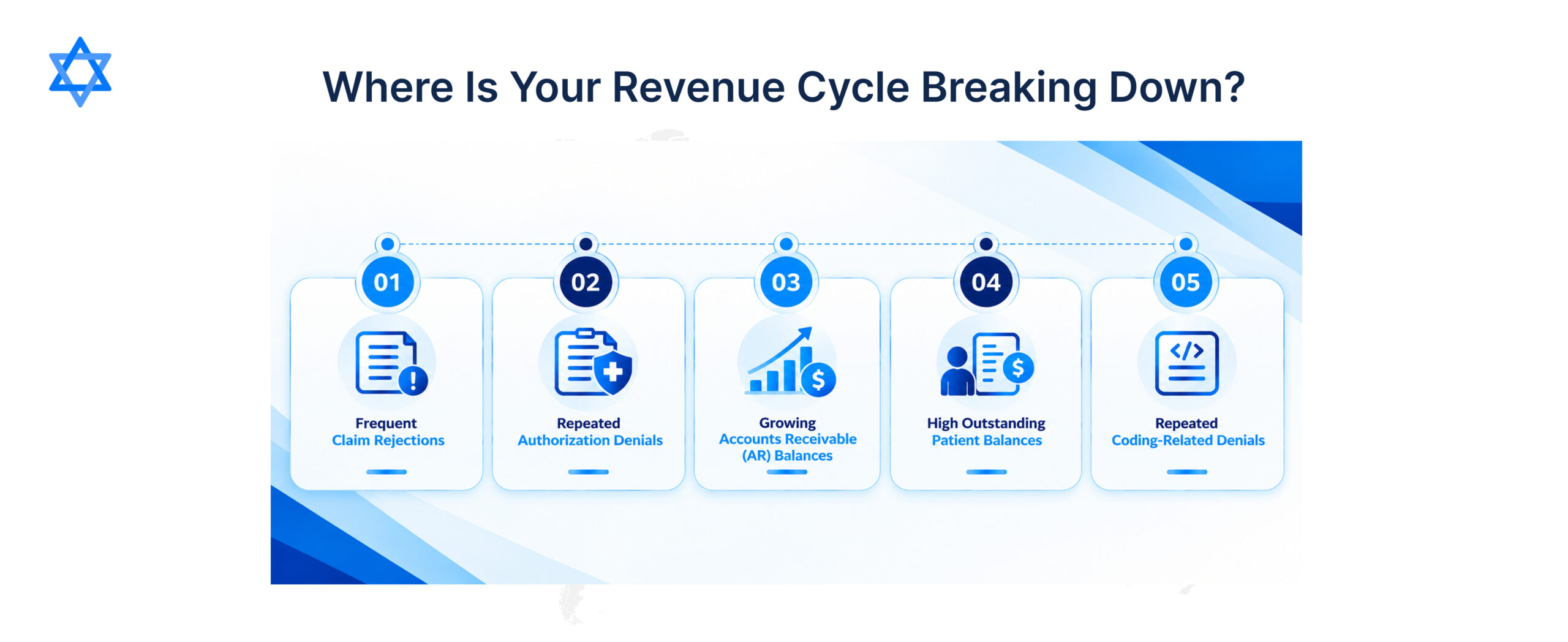
- Frequent Claim Rejections: Incorrect patient details or missing claim information can cause rejections. Review registration records and check claims for errors before submission.
- Repeated Authorization Denials: Missing or delayed prior authorization can lead to claim denials. Check payer requirements early and track authorization status before treatment.
- Growing Accounts Receivable (AR) Balances: Unpaid claims can pile up when follow-ups are delayed. Review AR aging reports regularly and assign clear responsibility for outstanding claims.
- High Outstanding Patient Balances: Confusing bills or limited payment options may delay patient payments. Provide clear statements and make payment options easy to understand and use.
- Repeated Coding-Related Denials: Incorrect medical codes or incomplete documentation can affect claim processing. Review coding practices and ensure submitted claims match the supporting clinical records.
A Simple 30-Day Plan to Improve Healthcare RCM
A short improvement plan can help practices focus on the problems that matter most without changing every workflow at once.
| Timeline | Focus | Actions |
| Week 1 | Identify problems | Review denials, AR aging, claim rejections, and overdue tasks |
| Week 2 | Fix front-end issues | Improve registration, eligibility checks, and authorization tracking |
| Week 3 | Improve claims and follow-up | Review claim accuracy, denial handling, and AR work queues |
| Week 4 | Measure and standardize | Compare results, document improved workflows, and assign ongoing responsibilities |
At the end of the month, compare performance with the original baseline. Identify which changes helped, which problems remain, and what needs further attention.
This is a starting framework, not a guarantee of improved collections within 30 days. Results depend on the practice’s starting point, claim volume, staffing, payer response times, and the changes implemented.
When to Consider RCM Support and How VBS Global Helps
Healthcare practices may need additional RCM support when claim denials keep recurring, accounts receivable (AR) balances grow, or internal teams struggle to manage billing and payment follow-ups.
Before choosing an external provider, review its healthcare experience, service scope, reporting process, data security, communication, and pricing.
VBS Global provides Revenue Cycle Management Services for healthcare providers in the USA. Support includes key activities such as:
- Claims management and follow-up
- Denial management
- Payment posting
- Accounts receivable follow-up
- Patient billing support
- Revenue cycle reporting
If your practice faces recurring claim issues, delayed payments, or growing AR balances, reviewing your current workflow can help identify where additional support may be needed.
Conclusion
Improving healthcare revenue cycle management starts with finding where billing and payment processes break down. Better insurance verification, accurate claims, consistent denial management, timely AR follow-up, and regular performance reviews can help practices manage revenue more effectively.
Start by measuring current performance, identifying one major problem, and reviewing the results after making a targeted change. If internal resources are not enough, consider whether external support can help youTr practice build a more consistent revenue cycle.
Need help improving your healthcare billing workflow? Explore VBS Global revenue cycle management to discuss your practice’s claims, denial management, and accounts receivable needs.
FAQs
1. How can healthcare practices improve revenue cycle management?
Start by verifying insurance information, checking authorization requirements, submitting accurate claims, tracking denials, following up on unpaid balances, and reviewing performance metrics regularly.
2. What are the most common healthcare revenue cycle management challenges?
Common challenges include eligibility errors, missing authorizations, coding and documentation problems, claim denials, delayed AR follow-up, patient billing issues, and limited performance reporting.
3. Which revenue cycle management metrics should practices track?
Useful metrics include claim denial rate, clean claim rate, days in AR, and net collection rate. Practices should use consistent definitions and review trends over time.
4. How can a practice reduce medical billing claim denials?
Verify patient and insurance details, confirm authorization requirements, review coding and documentation, and check claims before submission. Medical billing outsourcing can also help practices manage billing tasks and address recurring claim denial issues.
5. Does healthcare revenue cycle management software prevent all billing errors?
No. Software can flag certain errors and automate tasks, but accurate data, trained staff, clear workflows, and regular review remain important.
6. When should a healthcare practice consider outsourcing RCM?
A practice may consider outsourcing when internal teams struggle with denials, delayed collections, growing AR balances, staffing shortages, or consistent claim follow-up. The decision should account for cost, service scope, security, and reporting needs.