

Managing the financial side of healthcare can become increasingly difficult as patient volumes grow, billing requirements become more complex, and payment delays start affecting cash flow. A healthcare provider may have a capable internal team, but keeping up with claims, denials, accounts receivable, payment follow-ups, and changing administrative demands can still strain day-to-day operations.
This is why many healthcare organizations consider outsourced RCM services when their existing revenue cycle process becomes difficult to manage efficiently. Outsourcing can provide access to dedicated RCM professionals and structured processes without requiring the organization to build a larger internal team.
But outsourcing is not automatically the right choice for every healthcare provider. The decision depends on factors such as claim volume, denial rates, accounts receivable, staffing capacity, reporting needs, and the level of RCM expertise available internally.
So, when should a healthcare provider consider outsourcing revenue cycle management? This guide covers key warning signs, what an outsourced RCM partner can handle, and factors healthcare organizations should consider before deciding.
What Does Revenue Cycle Management Outsourcing Mean?
Revenue cycle management services outsourcing means working with an external team to manage some or all of the financial and administrative activities involved in the healthcare revenue cycle.
Depending on the provider and service scope, an outsourced RCM partner may support areas such as patient eligibility verification, medical billing, claims submission, payment posting, denial management, accounts receivable follow-up, and reporting.
Instead of hiring, training, and managing a larger internal billing team for every stage of the process, healthcare organizations can work with an experienced external team and scale support based on their operational requirements. This approach is often referred to as outsourced revenue cycle management.
The goal is not simply to move billing work outside the organization. A well-managed outsourcing arrangement should provide structured processes, better visibility, specialized expertise, and support for the organization’s revenue cycle goals.
9 Signs Your Healthcare Organization Should Consider RCM Outsourcing
1. Your Claim Denial Rate Is Increasing
Frequent claim denials can create additional work for billing teams and delay reimbursement. When claims need repeated review, correction, and resubmission, the revenue cycle can become slower and more difficult to manage.
If your organization is experiencing a consistent increase in denied claims, it may be worth evaluating whether your current RCM process has the resources and expertise needed to manage them effectively.
2. Accounts Receivable Is Taking Too Long to Collect
Growing accounts receivable can affect cash flow and make it difficult to understand the actual financial position of a healthcare organization.
If unpaid claims remain outstanding for extended periods, consistent follow-up becomes essential. An outsourced RCM team can provide dedicated support for tracking outstanding claims and managing the accounts receivable process, while Outsourced Bookkeeping and Accounting Services can support broader financial record management.
3. Your Billing Team Is Overloaded
As patient and claim volumes increase, an internal billing team may struggle to keep up with daily workloads.
When staff are constantly dealing with claim submissions, follow-ups, payment posting, and administrative tasks, important activities can get delayed.
Outsourcing can provide additional capacity without requiring the organization to immediately expand its internal team.
4. Claims Are Frequently Rejected or Delayed
Rejected or delayed claims can happen because of eligibility issues, missing information, documentation problems, coding errors, or payer-specific requirements.
If these issues happen regularly, they can create unnecessary rework and delay payments. Reviewing the underlying causes and improving the claims process can help reduce avoidable delays.
5. Revenue Cycle KPIs Are Difficult to Track
Healthcare providers need visibility into the performance of their revenue cycle.
Important metrics may include:
- Claim denial rate
- Days in accounts receivable
- Clean claim rate
- Collection rate
- Payment turnaround time
- Outstanding AR
- Net collection rate
If your organization does not have consistent reporting or finds it difficult to track these metrics, an RCM partner with structured reporting processes may provide additional visibility. Investing in management reporting services can also help healthcare organizations get a clearer picture of their overall financial performance alongside RCM reporting.
6. Administrative Costs Keep Increasing
Managing RCM internally involves more than employee salaries. Healthcare organizations may also need to consider recruitment, training, software, management time, employee turnover, and ongoing process improvements.
When the overall cost of maintaining an internal RCM operation continues to increase, outsourcing can be evaluated as an alternative operating model.
The right choice depends on the organization’s size, claim volume, internal capabilities, and service requirements.
7. You Are Expanding Your Practice or Healthcare Operations
Growth can put pressure on existing revenue cycle processes.
Adding new providers, locations, specialties, or increasing patient volume may require additional billing capacity and more structured processes.
If the current team is already operating at full capacity, outsourcing can provide additional support as the organization grows.
8. Your Team Lacks Specialized RCM Expertise
Healthcare billing involves payer requirements, claim follow-up, denial management, documentation, payment posting, and other specialized processes.
If your internal team does not have enough experience in specific areas of revenue cycle management, working with an experienced RCM service provider may help fill those operational gaps.
9. Your Staff Spends More Time on Billing Than Patient-Centered Work
Administrative work can take significant time away from the core responsibilities of a healthcare organization.
When staff spend a large portion of their working hours dealing with billing and revenue cycle tasks, outsourcing selected RCM activities can allow internal teams to focus more on their primary responsibilities.
When Is RCM Outsourcing the Right Decision?
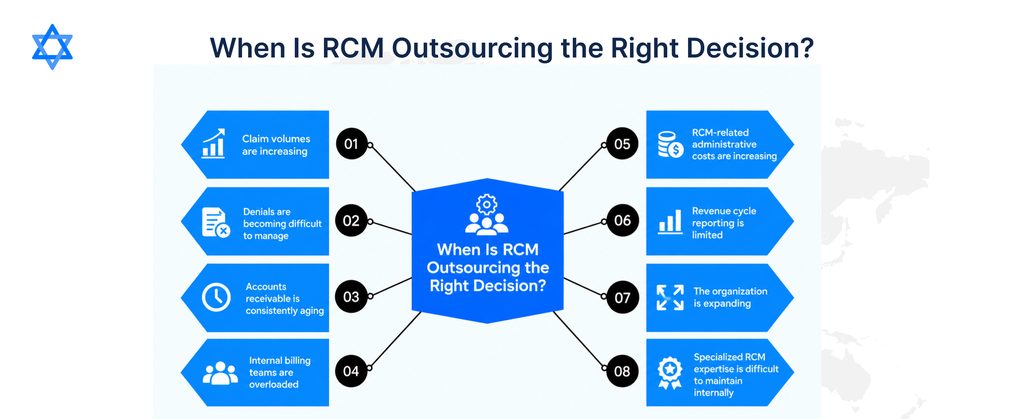
There is no single point at which every healthcare provider should outsource revenue cycle management.
The decision usually depends on a combination of operational, financial, and staffing factors.
Outsourcing may be worth evaluating when:
- Claim volumes are increasing
- Denials are becoming difficult to manage
- Accounts receivable is consistently aging
- Internal billing teams are overloaded
- RCM-related administrative costs are increasing
- Revenue cycle reporting is limited
- The organization is expanding
- Specialized RCM expertise is difficult to maintain internally
Before making a decision, healthcare providers should review their current RCM performance, identify the biggest gaps, and determine which functions they actually need external support for. Comparing different RCM outsourcing services based on scope, expertise, reporting, security, and communication can also help with the evaluation.
In-House vs. Outsourced RCM: What Should Healthcare Providers Consider?
Both models can work depending on the organization’s requirements.
| Factor | In-House RCM | Outsourced RCM |
| Staffing | Internal hiring and management | External specialized team |
| Training | Managed internally | Provider-supported training |
| Scalability | Depends on internal capacity | Can scale based on requirements |
| Expertise | Depends on available staff | Access to specialized RCM experience |
| Management | Internal oversight | Managed through agreed processes and reporting |
| Technology | Organization manages its own setup | May access provider-supported systems and tools |
Outsourcing does not automatically guarantee lower costs or better results. Healthcare providers should compare the total operational requirements, expected service scope, reporting, communication, security, and expertise before making a decision.
What Services Can an Outsourced RCM Partner Handle?
The exact scope depends on the provider and the agreement, but outsourced revenue cycle management may include several stages of the billing process.
Common areas of healthcare RCM services include:
- Patient eligibility verification
- Medical billing
- Claims submission
- Claims follow-up
- Denial management
- Payment posting
- Accounts receivable management
- Patient billing support
- Revenue cycle reporting and analytics
Healthcare providers should clearly define which activities they want to outsource and which responsibilities will remain with their internal team.
How to Choose the Right RCM Service Provider
Choosing an RCM service provider requires more than comparing service lists or pricing.
Healthcare organizations should evaluate:
Healthcare RCM Experience
Look for experience working with healthcare organizations and an understanding of the revenue cycle challenges relevant to your practice or specialty.
Denial Management Process
Ask how the provider identifies, tracks, resolves, and prevents recurring claim denials.
Reporting and Transparency
The provider should offer clear reporting that allows you to understand revenue cycle performance and identify areas that need attention.
Data Security
Healthcare financial and patient information requires appropriate security and privacy practices. Ask how data is handled, protected, and accessed.
Technology and Integration
Understand which billing, practice management, EHR, or other systems the provider can work with and how information will be exchanged.
Communication
Define who will manage communication, how often reports will be shared, and how issues will be escalated.
Scalability
The RCM partner should be able to support changes in claim volume, providers, locations, or service requirements as your organization grows.
Performance Tracking
Before starting an engagement, agree on the KPIs that will be monitored and how performance will be reviewed.
When evaluating a revenue cycle management company, healthcare providers should also consider whether its service scope and working model align with their specific operational requirements.
Why Healthcare Providers Choose VBS Global for RCM Support
Choosing an RCM partner is an important decision because revenue cycle activities directly affect a healthcare organization’s financial operations. The right partner should understand the challenges involved in healthcare billing, claims, payment follow-up, and revenue cycle reporting.
VBS Global provides Revenue Cycle Management services for healthcare organizations that need structured support with their revenue cycle operations. The team supports essential RCM activities while helping healthcare organizations maintain better visibility across processes that affect claims, payments, and accounts receivable.
VBS Global takes a practical approach to RCM support based on each organization’s operational requirements. Depending on the scope of support required, healthcare organizations can receive assistance with areas such as:
- Medical billing and claims management
- Claims follow-up and denial management
- Accounts receivable support
- Payment posting
- Revenue cycle reporting
- Ongoing RCM process support
This approach allows healthcare organizations to evaluate which parts of their revenue cycle require external support rather than taking a one-size-fits-all approach.
For organizations that also need broader financial oversight, outsourced virtual CFO services can provide strategic financial leadership alongside day-to-day RCM support, helping healthcare providers make more informed decisions about growth, costs, and financial planning.
Explore VBS Global’s revenue cycle management services to discuss your requirements and determine the right level of RCM support for your organization.
Is RCM Outsourcing Right for Your Healthcare Organization?
RCM outsourcing can be worth considering when revenue cycle challenges begin affecting cash flow, staff capacity, claim performance, or operational efficiency.
If your organization is dealing with increasing claim denials, growing accounts receivable, billing workload, limited reporting, or a lack of specialized RCM expertise, it may be time to review your current process and evaluate external support.
The first step does not have to be outsourcing the entire revenue cycle. Healthcare providers can identify their biggest challenges and determine whether selective or comprehensive outsourced RCM services make sense for their organization.
For healthcare organizations looking for professional revenue cycle management services, working with an experienced RCM partner can provide additional resources for managing day-to-day revenue cycle activities and improving process visibility across Revenue Cycle Management in Healthcare.
Frequently Asked Questions
1. What is RCM outsourcing in healthcare?
RCM outsourcing is the practice of working with an external service provider to manage selected or complete revenue cycle activities, such as billing, claims, payment posting, denial management, and accounts receivable follow-up.
2. When should a medical practice outsource RCM?
A medical practice may consider outsourcing when claim denials increase, accounts receivable remains outstanding for longer periods, billing staff is overloaded, administrative costs increase, or the organization lacks specialized RCM expertise.
3. Is outsourced RCM suitable for small healthcare practices?
It can be, depending on the practice’s claim volume, staffing requirements, operational complexity, and budget. Smaller practices can evaluate outsourcing when maintaining a full internal RCM team becomes difficult.
4. What does an outsourced RCM company handle?
Depending on the service agreement, an outsourced RCM company may handle eligibility verification, medical billing, claims submission, denial management, payment posting, AR follow-up, and revenue cycle reporting.
5. How can RCM outsourcing help with claim denials?
An experienced RCM team can help monitor rejected and denied claims, identify recurring issues, follow up on outstanding claims, and maintain a structured process for resolving billing problems.
6. How do I choose an RCM service provider?
Evaluate the provider’s healthcare RCM experience, denial management process, reporting capabilities, security practices, technology compatibility, communication process, scalability, and performance tracking.
Ready to Evaluate Your Revenue Cycle?
If your healthcare organization is facing growing claim denials, aging accounts receivable, billing workload, or limited RCM resources, VBS Global can help you evaluate your revenue cycle requirements.
Explore Revenue Cycle Management Services or Get a Free RCM Assessment to discuss your requirements with the VBS Global team.