


Running a small business in the UK involves much more than attracting customers and delivering quality products or services. Business owners must also manage invoices, monitor cash flow, record expenses, reconcile bank transactions and maintain accurate financial records. Without a reliable bookkeeping system, these responsibilities can quickly become overwhelming.
Professional bookkeeping services for small business in UK can help sole traders, freelancers, startups and limited companies maintain organised accounts, understand their financial position and prepare for important tax deadlines. Whether you operate an online store, consultancy, construction business or local service company, effective bookkeeping gives you greater control over your money.
In this guide, we explain what small business bookkeeping involves, which services you may need, how much it can cost, how digital accounting works and how to choose a suitable bookkeeping provider.
What Are Bookkeeping Services for Small Business in UK?
Bookkeeping is the process of recording, organising and maintaining a business’s financial transactions. It includes tracking sales, recording purchases, managing expenses, reconciling bank accounts and keeping financial information accurate and up to date.
For UK businesses, bookkeeping also helps maintain the records needed to prepare accounts, complete relevant tax returns and meet applicable HM Revenue & Customs (HMRC) requirements.
Professional bookkeeping services for small businesses may include:
- Recording sales invoices and customer payments.
- Managing supplier invoices and business expenses.
- Reconciling bank and credit card transactions.
- Monitoring accounts payable and accounts receivable.
- Maintaining digital accounting records.
- Preparing regular income and expenditure reports.
- Supporting VAT record keeping and return preparation.
- Organising records for year-end accounts and tax work.
- Helping business owners understand cash flow and outstanding payments.
The exact services required depend on the business’s legal structure, turnover, transaction volume and reporting obligations.
For example, a freelance designer may need basic monthly bookkeeping, while an expanding e-commerce company might require inventory tracking, payment gateway reconciliation and more detailed financial reporting.
Why Do Small Businesses in the UK Need Professional Bookkeeping?
Many business owners initially manage their finances using spreadsheets or by recording transactions whenever they have spare time. This can work for a very small operation, but it becomes harder as transaction volumes increase.
Professional bookkeeping helps businesses build a consistent financial management process.
1. Maintain Accurate Financial Records
Accurate records help you understand how much money your business earns, where it spends money and what remains after expenses.
A bookkeeper can organise receipts, invoices, bank transactions and other supporting documents into a structured system. This makes financial information easier to review and reduces the risk of missing transactions.
HMRC explains that self-employed people need records of their business income, expenses and other relevant financial information to calculate profits and support their tax returns. https://www.gov.uk/self-employed-records/what-records-to-keep
2. Improve Cash Flow Management
Profit and cash flow are not the same thing. A business can report a profit while struggling to pay its bills because customers have not paid their invoices.
Regular bookkeeping helps you identify overdue customer payments, upcoming supplier bills and periods when cash may be limited.
For example, a small marketing agency might invoice customers £8,000 in one month but receive only £5,000 before payroll and software subscriptions become due. A clear cash flow report helps the owner plan for the shortfall.
3. Reduce Administrative Pressure
Business owners already manage sales, customer service, employees and daily operations. Maintaining accounts can take valuable time away from these priorities.
Outsourcing bookkeeping allows you to delegate repetitive financial administration while retaining oversight of important business decisions.
4. Prepare for Tax Deadlines
Disorganised records can make tax preparation stressful. When transactions are recorded consistently throughout the year, the information required for tax work is easier to gather.
A bookkeeper can help prepare organised records for your accountant or tax adviser. Depending on their qualifications and agreed scope of work, they may also support VAT returns and other accounting tasks.
Remember that bookkeeping support does not automatically include tax advice, statutory accounts or submission of every required return. Confirm which services are included in your agreement.
5. Make Better Business Decisions
Financial reports can help you understand whether your services are profitable, which customers contribute the most revenue and where costs are increasing.
With reliable monthly information, you can make better-informed decisions about pricing, recruitment, marketing expenditure and business expansion.
Types of Bookkeeping Services Available for Small Businesses
The right bookkeeping package depends on the size and complexity of your operations. Here are some common services to consider.
Monthly Bookkeeping Services
Monthly bookkeeping involves recording transactions, categorising income and expenses, reconciling accounts and preparing financial summaries.
This option suits small businesses that want regular oversight without employing an in-house bookkeeper.
Monthly bookkeeping may cover:
- Bank reconciliation.
- Sales and purchase records.
- Expense categorisation.
- Invoice tracking.
- Monthly profit and loss reports.
- Queries about missing receipts or transactions.
Online Bookkeeping Services
Online bookkeeping services UK allow business owners to share financial documents and access accounting information remotely.
Cloud accounting software can connect with bank feeds, store digital records and simplify collaboration between business owners, bookkeepers and accountants.
This arrangement can be especially useful for startups, remote teams, consultants and businesses operating across several locations.
VAT Bookkeeping and Record Management
VAT-registered businesses must maintain appropriate VAT records and follow the applicable filing requirements.
VAT bookkeeping can involve recording taxable sales and purchases, checking VAT invoices, maintaining the VAT account and preparing information for VAT return submission.
Most VAT-registered businesses must follow Making Tax Digital for VAT requirements unless an exemption applies. Businesses should check that their software and record-keeping processes meet the relevant rules.
Official guidance is available from HMRC: https://www.gov.uk/charge-reclaim-record-vat/keeping-vat-records
Accounts Payable and Receivable Management
Accounts payable refers to money your business owes suppliers. Accounts receivable refers to money customers owe your business.
A bookkeeper can organise supplier invoices, track payment due dates, monitor outstanding customer invoices and provide reports showing overdue balances.
This helps reduce missed payments, improve collection processes and maintain healthier working relationships with customers and suppliers.
Payroll Bookkeeping Support
Businesses that employ staff may need support organising payroll-related financial records, wages, deductions, pension contributions and associated payments.
Payroll processing can be offered as a separate service. Confirm whether your bookkeeping provider handles payroll calculations, payslips, PAYE submissions and pension administration or only records payroll transactions.
Year-End Bookkeeping Preparation
Year-end bookkeeping involves reviewing transactions, reconciling accounts, identifying missing documentation and preparing records for year-end accounting.
A well-organised year-end process can make it easier for an accountant to prepare the relevant financial statements and tax calculations.
However, the work required will differ between sole traders, partnerships and limited companies.
Who Needs Small Business Bookkeeping Services in the UK?
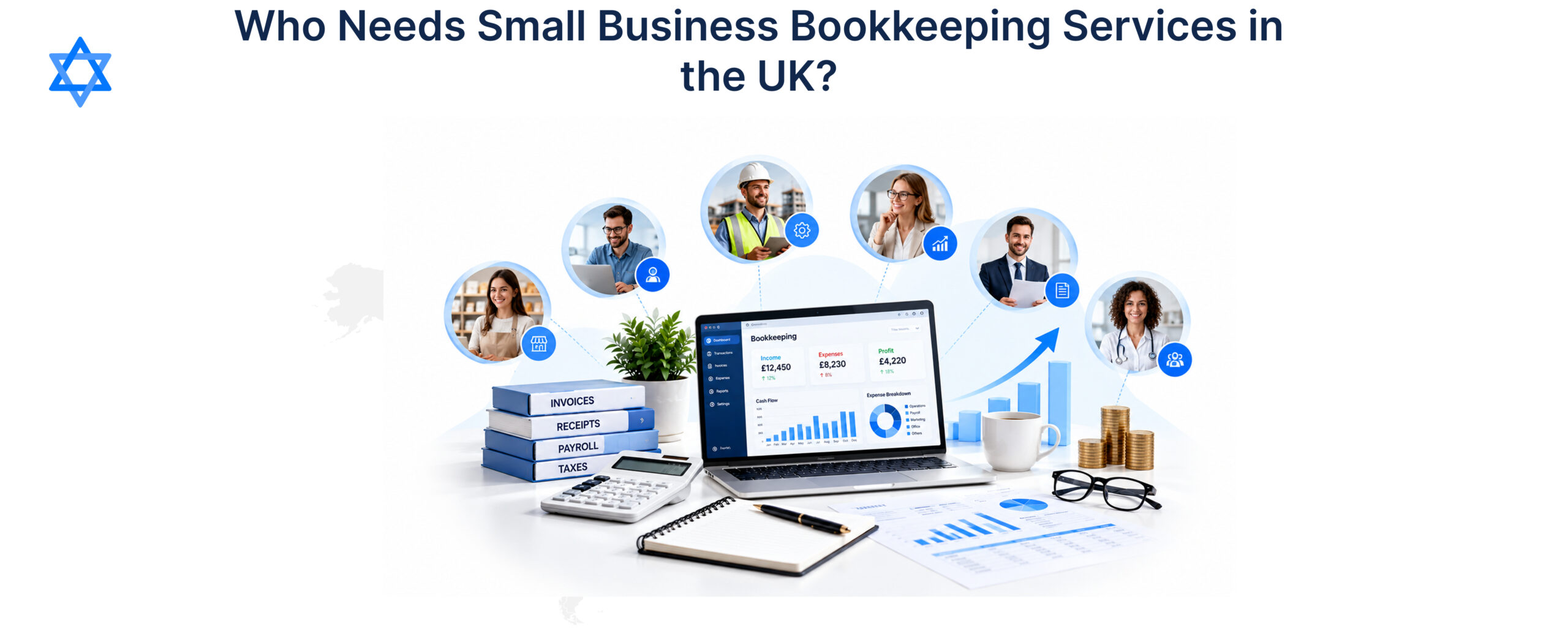
Bookkeeping is useful across many industries, although the requirements vary by business model.
Sole Traders and Freelancers
Sole traders and freelancers need to track business income, allowable expenses and other information relevant to their tax obligations.
A bookkeeper can help consultants, designers, tradespeople, photographers and independent professionals maintain clear records without spending hours updating spreadsheets.
Startups and New Businesses
New businesses benefit from establishing sound financial processes from the beginning.
A structured bookkeeping system helps founders monitor initial expenditure, record sales correctly and understand how much money is available to support growth.
Limited Companies
Limited companies generally need more structured financial records than a simple personal spreadsheet can provide.
Bookkeeping supports the preparation of company accounts, corporation tax work, VAT records where applicable and financial information needed by directors.
The precise obligations depend on the company and its circumstances.
E-Commerce Businesses
Online retailers may receive payments through multiple platforms, payment processors and marketplaces. Sales commissions, refunds, shipping charges and inventory purchases can make reconciliation more complicated.
E-commerce bookkeeping helps bring these transactions together so the business owner can understand revenue, costs and profitability.
Consultants and Professional Service Providers
Consultancies, marketing agencies, IT service providers and other professional businesses often need to track project income, software subscriptions, contractor costs and unpaid invoices.
Regular bookkeeping can help them assess project profitability and plan expenditure more effectively.
How Much Do Bookkeeping Services for Small Business in UK Cost?
The cost of bookkeeping depends on the number of monthly transactions, the complexity of your accounts, the accounting software used and the level of support required.
Common pricing models include a fixed monthly package, an hourly rate or a fee based on transaction volume.
A basic package may cover routine transaction recording and bank reconciliation. More comprehensive packages may include accounts payable, VAT support, payroll administration and monthly management reports.
Rather than choosing a provider solely because it advertises the lowest price, ask for a written breakdown of the services included.
Consider these questions before comparing quotations:
- How many transactions are included each month?
- Is bank reconciliation included?
- Does the package cover VAT record keeping or return preparation?
- Are payroll services available?
- Are monthly reports provided?
- Is accounting software included in the fee?
- Are year-end adjustments charged separately?
- What happens if your transaction volume increases?
Request quotations based on your actual requirements. This will help you compare providers fairly and avoid unexpected additional costs.
Online Bookkeeping vs In-House Bookkeeping
Small businesses often choose between hiring an employee, outsourcing bookkeeping or managing records internally.
Each approach has advantages.
In-House Bookkeeping
An in-house bookkeeper works directly within your business and may be available for daily financial administration.
This arrangement can suit larger businesses with frequent transactions or complex internal processes. However, employers must consider salary, recruitment, training, software and other employment costs.
Outsourced Bookkeeping
Outsourced bookkeeping gives you access to an external provider without employing a full-time member of staff.
It may be suitable for small businesses that require regular financial support but do not have enough work to justify a dedicated employee.
The quality of the service depends on the provider’s expertise, communication, processes and understanding of your business.
DIY Bookkeeping
Some small businesses can manage basic bookkeeping internally using accounting software or spreadsheets.
This approach offers direct control over the records, but it requires consistent attention and a clear understanding of bookkeeping principles.
As transaction volumes increase, outsourcing some or all of the work may become a practical option.
How to Choose the Best Bookkeeping Services for Small Business in UK
Selecting a bookkeeping provider is an important decision because the provider will handle sensitive financial information.
Use the following criteria when comparing options.
1. Check Relevant Experience
Look for a provider who understands your business type and transaction patterns.
For example, an online retailer may need marketplace reconciliation, while a construction business may need support tracking supplier invoices and project expenses.
Ask about similar businesses the provider has supported. Treat specific claims about experience, qualifications or results as matters to verify rather than assumptions.
2. Understand Qualifications and Professional Standards
Bookkeeping qualifications and membership of relevant professional bodies can provide useful evidence of training and professional commitment.
Check the provider’s credentials and understand the services they are qualified and authorised to deliver. Do not assume every bookkeeper is a chartered accountant or qualified tax adviser.
3. Review Software Compatibility
Ask which accounting platforms the provider supports and whether those platforms integrate with your existing systems.
Your bookkeeping setup should make it straightforward to share invoices, reconcile transactions and retrieve reports.
If you are subject to Making Tax Digital requirements, confirm that the proposed software and processes support your applicable obligations.
4. Evaluate Communication and Reporting
A reliable provider should explain how often records will be updated, which reports you will receive and how questions will be handled.
Monthly reporting can be particularly helpful because it gives business owners a regular opportunity to review financial performance.
5. Ask About Data Security
Bookkeeping involves bank information, invoices, customer details and potentially employee records.
Ask how documents are transferred, who can access your accounts, how data is backed up and what security measures are in place.
Review the provider’s privacy practices and contractual responsibilities before sharing sensitive information.
6. Request Transparent Pricing
Choose a provider who clearly explains their fees, deliverables, turnaround times and additional charges.
A suitable service should match your requirements and budget rather than simply offering the largest package.
Making Tax Digital and Bookkeeping Requirements in the UK
Making Tax Digital (MTD) is an important consideration when choosing bookkeeping services in UK.
MTD for VAT generally requires affected businesses to maintain relevant digital records and submit VAT returns using compatible software, unless an exemption applies.
MTD for Income Tax is being introduced in stages. From 6 April 2026, it applies to relevant sole traders and landlords with qualifying combined gross income from self-employment and property above £50,000. The threshold is scheduled to fall to above £30,000 from April 2027 and above £20,000 from April 2028, subject to the applicable rules.
Affected taxpayers generally need compatible software to maintain digital records and submit quarterly updates, along with the required year-end information.
Eligibility and obligations can depend on the type and amount of income involved. A bookkeeping provider should help you understand the processes relevant to your circumstances, but you should confirm your position using current HMRC guidance.
Read the official guidance: https://www.gov.uk/government/publications/digital-record-keeping-notice-for-making-tax-digital-for-income-tax
Common Bookkeeping Mistakes Small Businesses Should Avoid
Even a business with a good accounting system can encounter problems if financial records are not maintained consistently.
Mixing Personal and Business Transactions
Using separate business and personal accounts where practical makes transactions easier to identify and reconcile.
If personal transactions appear in business records, they should be identified and treated correctly rather than automatically classified as business expenses.
Delaying Bookkeeping Until Year-End
Leaving several months of transactions unrecorded creates unnecessary pressure and increases the risk of missing documents.
A weekly or monthly routine makes the process more manageable.
Forgetting to Track Outstanding Invoices
Unpaid invoices can create cash flow problems, even when sales appear strong.
Review outstanding customer balances regularly and follow up on overdue payments.
Misclassifying Expenses
Not every payment made by a business is necessarily an allowable tax deduction. Correct categorisation and appropriate supporting evidence help ensure that expenses are treated properly.
Seek qualified tax advice when the treatment of an expense is unclear.
Ignoring Reconciliation
Recording a transaction is not enough. Bank and payment processor balances should be reconciled against the accounting records to identify discrepancies, duplicate entries and missing transactions.
Benefits of Cloud-Based Bookkeeping for UK Small Businesses
Cloud accounting can make bookkeeping more accessible and efficient when it is configured appropriately.
Depending on the software, businesses may benefit from automated bank feeds, digital receipt capture, invoice creation, payment reminders and financial reporting.
Automation can reduce repetitive data entry, but it does not remove the need for human review. Transactions may be categorised incorrectly, bank feeds can fail and unusual payments may require investigation.
A good bookkeeping process combines suitable technology with regular checks and clear responsibility for reviewing the records.
Frequently Asked Questions About Small Business Bookkeeping in the UK
What does a bookkeeper do for a small business?
A bookkeeper records income and expenses, reconciles bank accounts, organises invoices, tracks payments and maintains financial records. Depending on the agreed service, they may also prepare reports and support VAT or payroll administration.
Do small businesses in the UK need a bookkeeper?
Not every small business must hire a bookkeeper. However, businesses need to maintain appropriate financial records and meet their applicable tax and reporting obligations. A bookkeeper can help manage this work accurately and consistently.
Can I outsource bookkeeping for my small business?
Yes. Many businesses use external bookkeeping providers instead of employing an in-house bookkeeper. Before outsourcing, agree on the scope of work, fees, reporting schedule, data security and responsibilities for submitting tax returns.
What is the difference between bookkeeping and accounting?
Bookkeeping focuses mainly on recording and organising financial transactions. Accounting generally involves interpreting financial information, preparing accounts and supporting tax or financial decisions. The exact services can overlap, depending on the provider’s qualifications and engagement.
How often should a small business update its books?
For many small businesses, weekly transaction recording and monthly reconciliation provide a useful routine. Businesses with high transaction volumes, payroll responsibilities or frequent payments may need more frequent checks.
How long should UK businesses keep bookkeeping records?
Record-retention requirements depend on the type of business, tax and records involved. Self-employed people generally need to keep records for at least five years after the 31 January submission deadline for the relevant tax year. VAT records generally need to be retained for at least six years, subject to applicable exceptions and specific rules.
Always check the rules that apply to your business and the particular records you hold.
Is online bookkeeping suitable for a new business?
Online bookkeeping can be a practical option for startups because it allows financial records to be organised from the beginning and shared with external advisers. Choose software and a service package that fit your transaction volume, budget and reporting needs.
Conclusion: Find the Right Bookkeeping Services for Your Small Business
Reliable bookkeeping is an important part of running a sustainable business. It helps you maintain accurate financial records, monitor cash flow, prepare for tax obligations and make informed decisions about future growth.
Whether you are a sole trader, freelancer, startup founder or limited company director, the right bookkeeping arrangement should fit your business structure, transaction volume and budget.
When comparing bookkeeping services for small business in UK, look beyond price. Consider the provider’s experience, software compatibility, reporting standards, data security and the precise services included in the agreement.
Start by reviewing your current bookkeeping process, identifying gaps and deciding which tasks you want to manage internally. A consistent system, supported by suitable software and professional assistance when needed, can make financial administration more manageable and give you a clearer picture of your business’s performance.
Ready to simplify your business bookkeeping? Get reliable bookkeeping support from VBS Global. Contact VBS Global to discuss your requirements and find the right solution for your business.
Disclaimer: This article provides general information about UK bookkeeping and record keeping. It is not a substitute for professional accounting or tax advice. Requirements may vary according to your business structure and circumstances. Verify current obligations with HMRC or a suitably qualified adviser.