

The month-end close process is a structured accounting procedure completed at the end of each month to verify financial transactions, reconcile accounts, record adjustments, and prepare financial statements. It helps businesses maintain accurate financial records, improve financial reporting, support compliance, and make informed business decisions.
Every month, businesses rely on the month-end close process to ensure their financial records are accurate, complete, and ready for reporting. A well-executed close not only improves financial visibility but also supports better decision-making and compliance.
The month-end close process is a key part of maintaining accurate financial records. When done well, it gives businesses a clear view of their financial performance. When delays or errors occur, reporting can suffer, and decision-making becomes more difficult.
In this guide, we explain what the month-end close process involves, outline the key steps, and share practical tips to help improve efficiency and accuracy.
What Is the Month-End Close Process?
The month-end close process includes a series of accounting tasks completed at the end of each month to review and finalise financial records. Many businesses also use professional Month-End Review Services to ensure this process is handled accurately and efficiently. It helps ensure all transactions are recorded, reconciled, and accurately reflected in financial reports.
In simple terms, it is a process of checking your books before moving into the next month. This helps confirm that transactions are recorded correctly and that any errors or missing entries are identified.
A well-managed month-end closing process helps businesses maintain accurate financial reporting, support tax compliance, and make better business decisions.
Why the Month-End Close Process Matters for Your Business
Many businesses treat the month-end close process as a routine accounting task. In reality, it is one of the most valuable financial practices for maintaining accurate records, improving cash flow visibility, and supporting better business decisions.
Financial Accuracy
The month-end close process ensures your financial records accurately reflect all business transactions for the accounting period. Well-maintained books lead to reliable financial statements, smoother tax preparation, and greater confidence in your business decisions.
Cash Flow Visibility
Closing your books each month provides a clear picture of your cash position by tracking incoming payments, outgoing expenses, and outstanding balances. This visibility helps you plan and identify potential cash flow issues before they become major problems.
Compliance and Audit Readiness
Accurate month-end closing records make tax filings, regulatory compliance, investor reporting, and financial audits much easier. Organized financial data also reduces the risk of reporting errors and compliance issues.
Better Business Decisions
Business decisions related to hiring, pricing, expansion, and investments should be based on reliable financial data. A well-prepared month-end report provides the insights business owners and management teams need to make informed decisions with confidence.
Early Detection of Errors
Regular month-end reviews help identify accounting errors, duplicate entries, missing transactions, and reconciliation issues before they affect future reporting periods. Many businesses use professional Outsourced Accounting Services to manage this process more efficiently. Resolving discrepancies early saves time and helps prevent costly financial mistakes.
Stronger Financial Reporting
A consistent month-end close process improves the quality of month-end reporting. It ensures your end-of-month reports are accurate, timely, and ready for stakeholders, lenders, or investors whenever needed.
Month-End Close Process: 7 Steps Explained
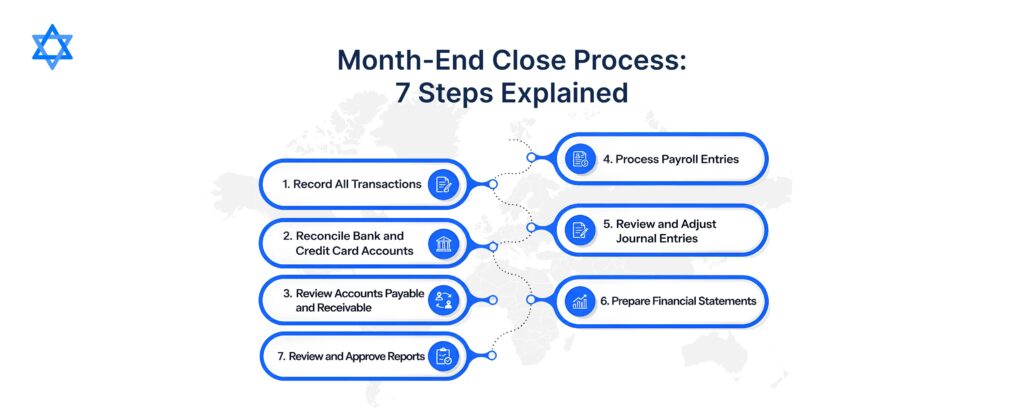
A structured approach makes the month-end close process manageable and consistent. Here are the seven core steps:
1. Record All Transactions
Start by confirming that every financial transaction for the month has been recorded in your accounting system. This includes sales, purchases, operating expenses, customer payments, supplier payments, bank charges, and any other financial activity. Missing transactions at this stage can create inaccuracies that affect every step of the closing process.
2. Reconcile Bank and Credit Card Accounts
Compare your bank and credit card statements with your books. Every transaction that appears on a bank statement should have a corresponding entry in your books and vice versa. For businesses that struggle with this step, outsource credit card reconciliation services can handle both bank and card reconciliation accurately every month, flagging and investigating any discrepancies before moving forward.
3. Review Accounts Payable and Receivable
Review all outstanding supplier invoices and customer receivables to ensure balances are accurate and up to date. Confirm that unpaid bills, outstanding invoices, and customer payments have been recorded correctly. This step provides a clear picture of your cash flow and helps avoid surprises in the next accounting period.
4. Process Payroll Entries
Payroll should also be reviewed before closing the books. Verify that employee salaries, tax withholdings, employer contributions, bonuses, and contractor payments have all been recorded correctly. Addressing payroll discrepancies now helps prevent reporting errors and compliance issues later.
5. Review and Adjust Journal Entries
Once the major transactions have been recorded, review your journal entries for any required adjustments. This typically includes accruals, prepaid expenses, depreciation, amortization, inventory adjustments, and corrections identified during reconciliations. Proper adjusting entries ensure your financial statements accurately reflect the month’s activity.
6. Prepare Financial Statements
With all transactions recorded and reconciled, generate your key financial statements, the profit and loss statement, balance sheet, and cash flow statement. These end-of-month reports show how outsourced bookkeeping works in practice, giving you a complete picture of your business’s financial performance and position for the month.
7. Review and Approve Reports
Before officially closing the accounting period, perform a final review of your financial statements. Look for unusual variances, unexpected account balances, or transactions that require further investigation. Once the reports have been reviewed and approved, you can confidently close the books and begin the next accounting period with accurate, reliable financial records.
Month-End Close Process Checklist
A consistent month-end closing checklist helps ensure every critical accounting task is completed before you close the books. Use the checklist below to improve accuracy, reduce errors, and keep your financial reporting on track each month.
Month-End Closing Checklist
- Record all transactions for the accounting period.
- Reconcile all bank accounts.
- Reconcile credit card accounts.
- Review and age accounts receivable.
- Review and age accounts payable.
- Verify payroll entries and tax withholdings.
- Record accruals and prepaid expenses.
- Process depreciation and amortization entries.
- Review and adjust journal entries.
- Verify inventory balances (if applicable).
- Prepare the profit and loss statement.
- Prepare the balance sheet.
- Prepare the cash flow statement.
- Review all financial reports for accuracy.
- Document any prior-period adjustments.
- Obtain final approval before closing the accounting period.
Common Challenges in the Month-End Close Process
Even with a well-defined process, month-end closing can become time-consuming and stressful. Delays, manual errors, and inconsistent procedures often prevent businesses from closing their books on time. Below are some of the most common challenges finance teams face during the month-end close process.
Missing or Late Transactions
Late expense reports, supplier invoices, payroll adjustments, or other financial transactions can delay the entire closing process. Establishing clear submission deadlines and reviewing transactions throughout the month helps minimize last-minute surprises.
Manual Data Entry Errors
Businesses that rely heavily on manual data entry are more likely to encounter duplicate entries, incorrect account classifications, and simple typing mistakes. These errors can affect financial reports and may not be discovered until future accounting periods.
Lack of Standardized Processes
Without a documented month-end close procedure, different team members may follow different workflows, leading to inconsistencies and unnecessary delays. A standardized process improves accuracy, accountability, and makes onboarding new accounting staff much easier.
Reconciliation Backlogs
When bank and credit card reconciliations are postponed until the end of the month, finance teams often face unnecessary pressure to complete everything within a short timeframe. Performing reconciliations regularly throughout the month makes the closing process faster and more accurate.
Poor Communication Between Teams
A successful month-end close often depends on information from multiple departments, including finance, payroll, operations, and management. Miscommunication or delayed approvals can slow the process and postpone financial reporting.
Limited Internal Resources
Many small and growing businesses have lean accounting teams that already manage multiple responsibilities. As workloads increase, completing the month-end close accurately and on time becomes more challenging. In these situations, outsourcing month-end close services alongside CFO Services for Small Business can help maintain accuracy, improve financial oversight, and reduce pressure on internal staff.
How Long Should the Month-End Close Process Take?
This is one of the most common questions finance teams ask, and the honest answer depends on the size and complexity of your business.
As a general benchmark:
| Business Type | Average Close Time |
| Small business | 1–3 days |
| Growing business | 3–5 days |
| Large business | 5–10 days |
Many businesses take longer than these benchmarks, often because of manual processes, reconciliation backlogs, or a lack of clear ownership. If your month-end close consistently takes more than a week for a small business, it is worth reviewing your process.
Signs Your Month-End Close Process Needs Improvement
Not sure if your current process is working as efficiently as it should? Here are some common warning signs:
- Close Takes Too Long
If you are still finalizing last month’s books well into the new month, it may be a sign that your closing process is slow or inefficient. - You Regularly Find Errors After Close
Frequent mistakes discovered after closing often indicate gaps in your review or reconciliation process. - Your Team Dreads Month-End
If month-end consistently brings stress, overtime, and frustration, your workflow may need improvement. - Reports Are Delayed
Delayed month-end reporting can make it difficult for leadership to access timely financial insights and make informed business decisions. - You Cannot Explain Variances
If unexpected changes in financial reports cannot be explained quickly, your review process may not be thorough enough.
Best Practices to Improve Your Month-End Close Process
Improving your month-end close does not always require major changes. A few simple improvements can make the process smoother and more efficient.
1. Set Clear Deadlines
Set clear cutoff dates for transaction submissions, including expense reports, supplier invoices, and payroll inputs. Make sure everyone involved knows these deadlines.
2. Reconcile Throughout the Month
Avoid leaving all reconciliations until the end-of-month reports. Reviewing accounts regularly can make the month-end closing faster and easier.
3. Standardize Your Process
Use a clear checklist for every step of the close process. This helps reduce errors and ensures important tasks are not missed.
4. Use Cloud-Based Accounting Software
Tools like Xero, QuickBooks, and Zoho Books can automate routine tasks such as reconciliation and report generation, helping save time and reduce manual work.
5. Assign Clear Ownership
Each step in the closing process should have a responsible team member. Clear ownership improves accountability and reduces delays.
6. Review and Improve Regularly
After each close, review what worked well and identify areas that caused delays. Small improvements over time can lead to a much more efficient process.
Benefits of Outsourcing Your Month-End Close Process
For many businesses, especially small and medium-sized companies, outsourcing the month-end close process can help improve efficiency and reduce workload.
Consistent Accuracy
Professional accounting teams follow structured workflows and review processes, helping ensure accurate and reliable financial reports each month.
Faster Close Times
Experienced teams can often complete the closing process more efficiently, reducing delays and improving reporting timelines.
Reduced Internal Workload
Your internal team can stay focused on day-to-day responsibilities while the month-end close is handled by experienced professionals.
Access to Expert Knowledge
Outsourced accounting professionals bring expertise in accounting standards, compliance requirements, and industry best practices.
Better Financial Visibility
Using cloud-based platforms like Xero and QuickBooks, businesses can access up-to-date financial data and reports more easily.
Cost Efficiency
Outsourcing can reduce the cost of hiring, training, and managing additional in-house accounting staff while providing predictable monthly costs.
Why Businesses Choose VBS Global for Month-End Close
At VBS Global, we provide professional Outsourced CFO Services for businesses across the USA, UK, and Australia. Our Outsourced Accounting team manages every stage of the month-end close process, from reconciliation to financial reporting.
When you partner with VBS Global, you benefit from:
- Complete month-end close support
- Bank and credit card reconciliation
- Accounts payable and receivable review
- Payroll entry processing and verification
- Adjusting journal entries and accruals
- Preparation of profit and loss, balance sheet, and cash flow reports
- Cloud-based support through Xero, QuickBooks, and Zoho Books
- Dedicated team with responsive support
- Timely delivery of accurate financial reports
At VBS Global, we help businesses close their books accurately and on time every single month. Book a Free 30-Minute Consultation and let our month-end close experts take the pressure off your finance team today.
Conclusion
The month-end close process is more than just an accounting task. It is a key part of keeping your financial records accurate and understanding your business performance.
When the process runs smoothly, financial reports are prepared on time, giving you a clear view of your business. When it does not, delays and errors can affect reporting and decision-making.
If your month-end close process is taking too long or creating unnecessary stress, partnering with experienced accounting professionals can help you close your books faster, improve reporting accuracy, and free up valuable time for strategic business growth.
FAQs
1. What is the month-end close process?
The month-end close process includes accounting tasks completed at the end of each month to finalise financial records, reconcile accounts, and prepare accurate financial statements.
2. Why is month-end closing important?
Month-end closing helps keep financial records accurate and up to date. It supports better decision-making, cash flow monitoring, tax compliance, and audit readiness.
3. How long should the month-end close take?
For small businesses, the process usually takes 1 to 3 days. Growing SMEs may take 3 to 5 days. If it regularly takes longer, it may be worth reviewing your current process.
4. What are common month-end closing mistakes?
Common mistakes include missing transactions, delayed reconciliations, manual entry errors, and unclear processes. These issues can slow down the close and affect reporting accuracy.
5. Can small businesses outsource month-end close?
Yes. Many small businesses outsource month-end closing to improve accuracy, reduce workload, and gain access to professional accounting support.
6. What are outsourced month-end close services?
Outsourced month-end close services involve a professional accounting team managing tasks such as reconciliation, journal entries, financial statement preparation, and report delivery using secure cloud-based systems.