
Running a small business means wearing a lot of hats. Sales, operations, customer service, marketing, the list never ends. And somewhere at the bottom of that list, often getting less attention than it deserves, is bookkeeping.
For many small business owners, bookkeeping starts as something manageable. A spreadsheet here, a receipt pile there. But as the business grows, small business bookkeeping quietly becomes one of the biggest sources of stress, confusion, and financial risk.
The good news is that there are clear signs your bookkeeping has outgrown your current approach, and recognising them early can save you significant time, money, and headaches.
In this guide, we will walk you through seven signs that your small business bookkeeping needs professional support, what happens when those signs are ignored, and how the right bookkeeping partner can make a real difference.
What is Small Business Bookkeeping?
Small business bookkeeping is the process of recording, organising, and maintaining all financial transactions related to your business. This includes tracking income and expenses, reconciling bank accounts, managing invoices, processing payroll, and keeping accurate records up to date and ready for tax time.
Done well, bookkeeping gives you a clear picture of your business’s financial health at any point in time. Done poorly or not done at all, it creates confusion, compliance risk, and decisions made on inaccurate information.
For small businesses, bookkeeping is not just an administrative task. It is the financial foundation on which everything else is built.
Why Small Business Bookkeeping is Important
Many small business owners underestimate how much their bookkeeping affects the rest of their business. Here is why getting it right matters:
- Accurate Financial Picture: Clean books give you an honest view of your income, expenses, and profitability. Without accurate records, you are making decisions based on guesswork, not facts.
- Tax Compliance: Whether you are filing VAT returns, income tax, corporation tax, or payroll taxes, accurate bookkeeping is the foundation of every filing. Errors in your books mean errors in your tax returns, and that means penalties.
- Cash Flow Management: Knowing exactly what is coming in and going out and when is essential for managing cash flow. Poor bookkeeping makes this nearly impossible to track reliably.
- Business Growth: Investors, lenders, and partners will all want to see your financial records. Clean, accurate books make you look professional and prepared. Messy ones raise red flags and close doors.
7 Signs Your Small Business Needs Professional Bookkeeping Services
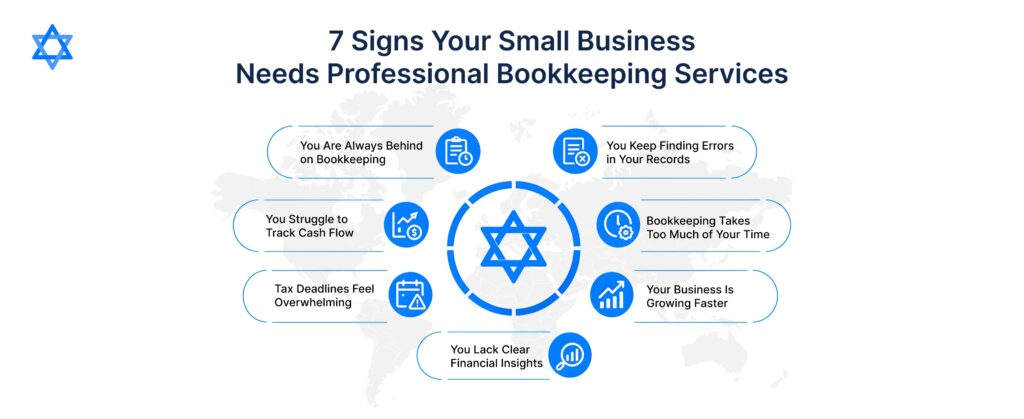
1. You Are Always Behind on Bookkeeping
If your bookkeeping is regularly weeks or months behind, your financial records do not reflect reality. You are making decisions about spending, hiring, and pricing based on outdated information.
Falling behind on small business bookkeeping is one of the most common warning signs. It usually starts with a busy week where the books get pushed aside. Then another. Before long, months of transactions need to be reconciled, and the task feels impossible to catch up on.
Bookkeeping help for small business owners who are behind can make an immediate difference, getting records back on track quickly and preventing the backlog from growing further.
2. You Struggle to Track Cash Flow
Cash flow is the lifeblood of any small business. You might be profitable on paper, but still run out of cash if your timing is off, with payments coming in late while bills go out on time.
If you regularly find yourself unsure whether you have enough cash to cover upcoming expenses, or are surprised by a shortfall you did not see coming, your bookkeeping is not giving you the visibility you need.
A professional bookkeeping team tracks every transaction, monitors receivables and payables, and shows how outsourced bookkeeping works to give you a forward-looking view of your cash position, so nothing catches you off guard.
3. Tax Deadlines Feel Overwhelming
Tax season should not be a crisis. If you spend weeks scrambling to pull together receipts, reconcile accounts, and organise financial records every time a tax deadline approaches, something is wrong with your bookkeeping process.
The problem is not the deadline; it is that your records are not tax-ready throughout the year. Professional small business bookkeeping keeps your records organised and compliant on an ongoing basis, so when tax time comes, the work is already done. Many businesses also choose to outsource tax preparation services alongside bookkeeping, ensuring both their records and their filings are handled by qualified professionals.
4. You Keep Finding Errors in Your Records
Duplicate transactions, missing invoices, unreconciled bank accounts, incorrectly categorised expenses, and bookkeeping errors are more common than most business owners realise, and they compound over time.
A single miscategorised expense might seem minor. But multiply that across hundreds of transactions over several months, and your profit and loss statement, your tax returns, and your cash flow projections could all be significantly inaccurate.
Professional bookkeepers follow structured processes and quality checks that catch errors before they become costly problems.
5. Bookkeeping Takes Too Much of Your Time
How many hours a week do you spend on bookkeeping? If the answer is more than a few, that is time taken away from the activities that actually grow your business, serving customers, developing products, building relationships, and driving sales.
For most small business owners, bookkeeping is not the best use of their time. It is important work, but it does not require the strategic thinking and business knowledge that only you can provide. Delegating it to a professional team frees you to focus on what matters most.
6. Your Business Is Growing Faster
Growth is exciting, but it also brings financial complexity. More clients, more transactions, more employees, more suppliers, more tax obligations. What worked when you were processing 50 transactions a month quickly becomes unmanageable at 500.
If your business is growing faster than your bookkeeping can keep up with, the gap between your financial records and financial reality will widen. Professional bookkeeping scales with your business, handling increased volume and complexity without missing a beat.
7. You Lack Clear Financial Insights
If someone asked you right now what your profit margin is, which products or services are most profitable, or how your revenue this quarter compares to last year, could you answer confidently?
If not, your bookkeeping is not delivering the insights your business needs. Professional small business bookkeeping goes beyond data entry. It produces clear, accurate financial reports that give you the information you need to make smarter decisions about your business. Financial management reporting services take this a step further, providing deeper analysis, trends, and strategic insights that help you plan with confidence.
What Happens When Small Business Bookkeeping Goes Wrong
Ignoring the signs above does not make the problem go away. Here is what happens when bookkeeping issues are left unaddressed:
- Tax Penalties
Inaccurate or late tax filings lead to penalties, interest, and in some cases, audits. The longer bookkeeping problems persist, the more expensive the consequences become. - Poor Business Decisions
Decisions made on inaccurate financial data, whether about hiring, investment, pricing, or expansion, can set your business back significantly. You cannot manage what you cannot measure. - Cash Flow Crises
Without proper tracking of receivables and payables, cash flow shortfalls can appear suddenly and without warning, creating financial stress that could have been avoided with better bookkeeping. - Compliance Issues
From VAT returns to payroll filings, compliance obligations require accurate records. Businesses without proper bookkeeping support are far more likely to face compliance failures and the penalties that come with them. - Difficulty Securing Funding
When you approach a bank or investor for funding, they will want to see clean, accurate financial records. Messy books signal financial mismanagement and make it significantly harder to secure the funding your business needs to grow.
Small Business Bookkeeping Checklist
Use this checklist to assess whether your current bookkeeping is keeping up with your business:
- Bank accounts are reconciled every month
- All income is recorded accurately and on time
- All expenses properly categorised
- Accounts receivable tracked outstanding invoices, followed up on
- Accounts payable managed bills paid on time
- Payroll processed accurately and on schedule
- VAT or sales tax is calculated and filed correctly
- Financial reports are reviewed monthly
- Records organised and tax-ready throughout the year
- No backlog of unrecorded transactions
If you ticked fewer than seven of these, your small business bookkeeping needs attention, and professional support could make a significant difference.
Benefits of Professional Small Business Bookkeeping Services
Investing in professional bookkeeping support delivers measurable benefits that go beyond simply keeping your records organised.
- Accurate and Up-to-Date Records
Clean and current records ensure you always have reliable financial data. Professional bookkeeping services help reduce errors and improve overall financial accuracy. - More Time to Focus on Growth
Managing books internally can consume valuable hours every week. Outsourced bookkeeping services free up your time so you can focus on operations, customers, and business growth. - Stress-Free Tax Compliance
Well-maintained records make tax preparation easier and reduce compliance risks. With proper bookkeeping support, deadlines and filings become far more manageable. - Better Cash Flow Management
Tracking receivables, payables, and expenses gives you better visibility into your cash position. Strong cash flow management helps you plan with confidence. - Improved Financial Reporting
Accurate profit and loss statements, balance sheets, and cash flow reports provide the insights needed for better business decisions. Reliable financial reporting services help identify opportunities and risks early. - Scalable Support as You Grow
As your business expands, financial complexity increases. The right service business bookkeeping owners scale with growth, ensuring consistent support at every stage.
How to Choose the Right Bookkeeping Service
Not every bookkeeping provider will be the right fit for your business. Choosing the right partner can improve accuracy, save time, and support long-term growth. Here are key factors to consider:
- Experience with Small Businesses
Choose a provider that understands the unique financial challenges of different industries, from retail and e-commerce to property management bookkeeping services, ensuring more accurate and industry-specific support. - Industry Expertise
A bookkeeping team familiar with your industry will better understand your transaction types, expense categories, and reporting requirements. Industry-specific knowledge improves both accuracy and efficiency. - Cloud-Based Technology
Modern bookkeeping should use cloud platforms such as Xero, QuickBooks, or Zoho Books, providing secure, real-time access to your financial data from anywhere. - Transparent Pricing
Look for transparent pricing with no hidden fees. A reliable bookkeeping provider should offer straightforward pricing and clearly defined service packages. - Responsive Communication
Strong communication matters. You should be able to reach your bookkeeping team easily and receive regular updates, reports, and timely support when needed. - Proven Track Record
Check client reviews, testimonials, and case studies. A provider with a strong track record of helping businesses is more likely to deliver reliable, long-term service.
Why Small Businesses Choose VBS Global for Bookkeeping
At VBS Global, we specialise in professional bookkeeping services for small businesses across the USA, UK, and Australia. Our team of qualified bookkeepers and accountants understands exactly what small businesses need accurate records, clear reports, and a reliable team they can count on.
Here is what you get with VBS Global:
- Weekly or monthly bookkeeping tailored to your transaction volume
- Bank and credit card reconciliation
- Accounts payable and receivable management
- Payroll processing and compliance support
- Monthly financial reports: profit and loss, balance sheet, cash flow
- Tax-ready records maintained throughout the year
- Cloud-based bookkeeping using Xero, QuickBooks, and Zoho Books
- Dedicated team with direct access and responsive communication
- Transparent, affordable pricing with no hidden fees
At VBS Global, we help small businesses stay organised, compliant, and financially clear so you can focus on growing your business with confidence. Book a Free 30-Minute Consultation and let our small business bookkeeping experts take care of your finances today.
Conclusion
Small business bookkeeping is not just a back-office task; it is the financial foundation your entire business depends on. When it works well, you have clarity, compliance, and confidence. When it does, the consequences can be costly.
If you recognised any of the seven signs in this guide, it is time to take your bookkeeping seriously. Professional support does not just fix the problem; it transforms how your business manages its finances, giving you the time, accuracy, and insight you need to grow.
Whether you are starting fresh or catching up on months of backlog, VBS Global is here to help you get your business bookkeeping services back on track accurately, efficiently, and stress-free.
FAQs
1. What is included in professional small business bookkeeping services?
Professional bookkeeping typically includes transaction recording, bank reconciliation, accounts payable and receivable management, payroll processing, and monthly financial reporting. Some providers also offer tax preparation support and virtual CFO services.
2. How much does small business bookkeeping cost?
Costs vary depending on transaction volume and service scope. Most bookkeeping services for small business owners range from $200 to $800 per month, making outsourced support more affordable than hiring a full-time employee.
3. Can I do my own bookkeeping using cloud software?
Yes, but it requires time, consistency, and accounting knowledge. Cloud tools like Xero and QuickBooks help automate tasks, but they do not replace professional expertise. As your business grows, outsourced bookkeeping services often become a more practical option.
4. How often should small business bookkeeping be done?
At a minimum, bookkeeping should be completed monthly. Businesses with higher transaction volumes often benefit from weekly bookkeeping to maintain accurate and up-to-date records.
5. What happens if I ignore bookkeeping problems?
Ignoring bookkeeping issues can lead to inaccurate records, compliance risks, tax penalties, and poor financial decisions. Addressing issues early helps prevent costly corrections later.